

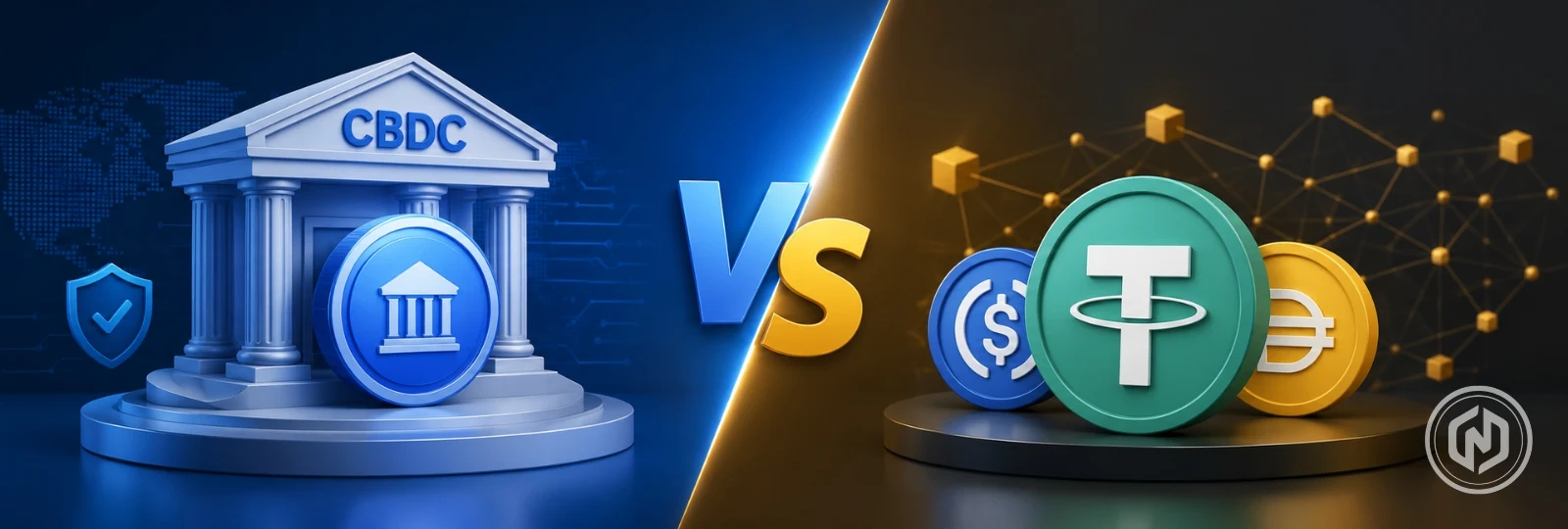


Many countries are running pilot projects for a digital version of their own legal tender despite the boom in the stablecoin market in the last few months. This digital version of legal tender issued by central banks is known as Central Bank Digital Currency. While some countries are developing it to boost digital payments, some governments are using it to counter the rise of stablecoins by providing an alternate option in order to keep the financial market regulated.
What is Central Bank Digital Currency (CBDC)?
CBDC, which is a short form of Central Bank Digital Currency, is the digital version of local fiat currency, like USD, which is issued and backed by the country’s central bank, such as the Federal Reserve in the U.S., the European Central Bank, or the Reserve Bank of India. These banks are using centralized systems or permissioned distributed ledger technology (DLT) to launch their own digital currency.
There are many purposes behind why governments are issuing digital currencies. One of the biggest reasons is that these digital versions of fiat currencies help the user to execute transactions in no time, whereas the current traditional financial system might take a long time to settle the transaction.
Apart from this, CBDC provides more inclusiveness to the people, as users without bank accounts are also able to use it through an application on their mobile phones.
However, there are many governments around the world that are working on Central Bank Digital Currency to curb the rise of cryptocurrencies, such as Bitcoin, Ethereum, etc and stablecoins like USDT.
What is Stablecoin?
Stablecoin is a type of cryptocurrency that is created to keep its value stable by maintaining its peg with real-world assets like USD. There are various types of stablecoins, such as fiat-collateralized, crypto-collateralized, and algorithmic.
These stablecoins are working as a bridge between the decentralized finance (DeFi) sector and the traditional financial world. From the dApps to cross-border payments, stablecoins are becoming a very useful and efficient option for digital transactions and payments.
There are popular stablecoins, such as USDT, USDC, USDE, and others.
Comparison Between Central Bank Digital Currency (CBDC) and Private Stablecoins
At this point in time, there is no direct competition between CBDC and stablecoins based on their market size. After receiving a much-needed regulatory clarity like the GENIUS Act, the stablecoin market capitalization has soared over $320 billion with the growing adoption of stablecoins like USDC, USDT, and others. The reason behind the growth in private stablecoins is their usefulness in the DeFi world. Apart from this, these stablecoins are also making their way into cross-border payments.
On the other hand, Central Bank Digital Currencies have failed to gain the attention of consumers around the world, as most of the projects are still under the development phase and going through pilot programs. There are around 146 countries around the world working on central bank digital currencies, which is more than 98% of global GDP. These include China’s eCNY, the Bahamas Sand Dollar, Nigeria eNaira, and Jamaica JAM DEX.
| CBDC | Private Stablecoins | |
| Issuer | Central banks of countries | Private companies and protocols such as Circle, Tether |
| Backing | Full faith, credit, and sovereign guarantee of the issuing government | Stablecoins are backed by reserves held by issuers. |
| Overall Market Capitalization | It is unknown as of due to small retail adoption. | More than $317 billion (at the time of writing) |
| Transactions | CBDC is mostly used for domestic payments. | Stablecoins have a large number of use cases, such as crypto trading, cross-border transactions, remittances, etc. |
| Privacy | There is constant government surveillance as it is issued by a regulated entity. | Most stablecoins are issued on the blockchain network, and this is why it has strong privacy. |
| Speed | Slower than stablecoins | Faster than CBDC |
| Regulation | It is already issued by a regulated entity like the central bank. | It is getting regulatory clarity, through GENIUS Act, MiCA, etc. |
Why Has the U.S. Banned CBDC?
After taking the Presidential chair in 2025, U.S. President Donald Trump signed an executive order to ban federal agencies from launching any kind of CBDC. It has also stopped any CBDC-related programs.
Sen. Mike Lee (R-UT) stated in the official statement that, “The United States doesn’t need to create a Central Bank Digital Currency to know it is a bad idea. We’ve seen this play out in China with the digital Yuan. In early trials, China canceled its citizens’ money after a set period, forcing Chinese citizens to spend their savings at the compulsion of the government. My bill protects Americans from a similar intrusion by prohibiting the Federal Reserve or any federal government agency from minting or issuing a CBDC, whether through a direct-to-consumer or intermediated model.”
“CBDCs are nothing more than a tool for tyrants to intimidate, control, and surveil the activities of American citizens, and it is my duty as a patriot to stop them,” he said.
According to government officials, privacy concerns related to CBDCs were one of the reasons behind the ban proposal. Officials argued that CBDCs could allow governments to monitor users’ transactions. They also warned that CBDCs could pull deposits away from commercial banks, potentially creating instability in the banking sector. Moreover, there were concerns about censorship and government control over transactions were also raised.
Can CBDCs and Stablecoins Coexist?
By looking at the current rate of adoption of stablecoin, it is expected that stablecoin will dominate the digital payment market in the upcoming time. According to a Citigroup report, the overall stablecoin market is expected to soar above $1.9 trillion. The main purpose of stablecoin is to boost cross-border transactions, and this is why many digital payments like PayPal’s PYUSD have integrated their own stablecoin.
Meanwhile, CBDCs are expected to target domestic retail payments. So, it is very likely that CBDC and stablecoin will coexist in the future.
Summing Up
Central Bank Digital Currency and stablecoins are two different types of digital assets. While CBDC is directly issued by the regulated financial institutions, stablecoins have gained the attention of digital payment companies like PayPal, as they can improve cross-border transactions. While both look the same from the outside, stablecoin has some kind of edge over CBDC due to the privacy it provides. Also, stablecoin transactions are known for low fees, and that is why many institutions are integrating it with their existing infrastructure.
However, many countries with large economies are testing a pilot of their CBDC, such as China. Some countries are also using CBDC to curb the rise of the stablecoin market and keep the financial world regulated. However, stablecoin’s privacy feature is still making it an attractive option for investors and traders. All in all, the adoption of stablecoins and CBDCs is expected to grow in the coming years.