



While the entire crypto sector is struggling to recover from the sharp crash due to growing geopolitical tension and a spike in the inflation rate, the real-world asset (RWA) market has grabbed headlines after its rapidly growing market capitalization.
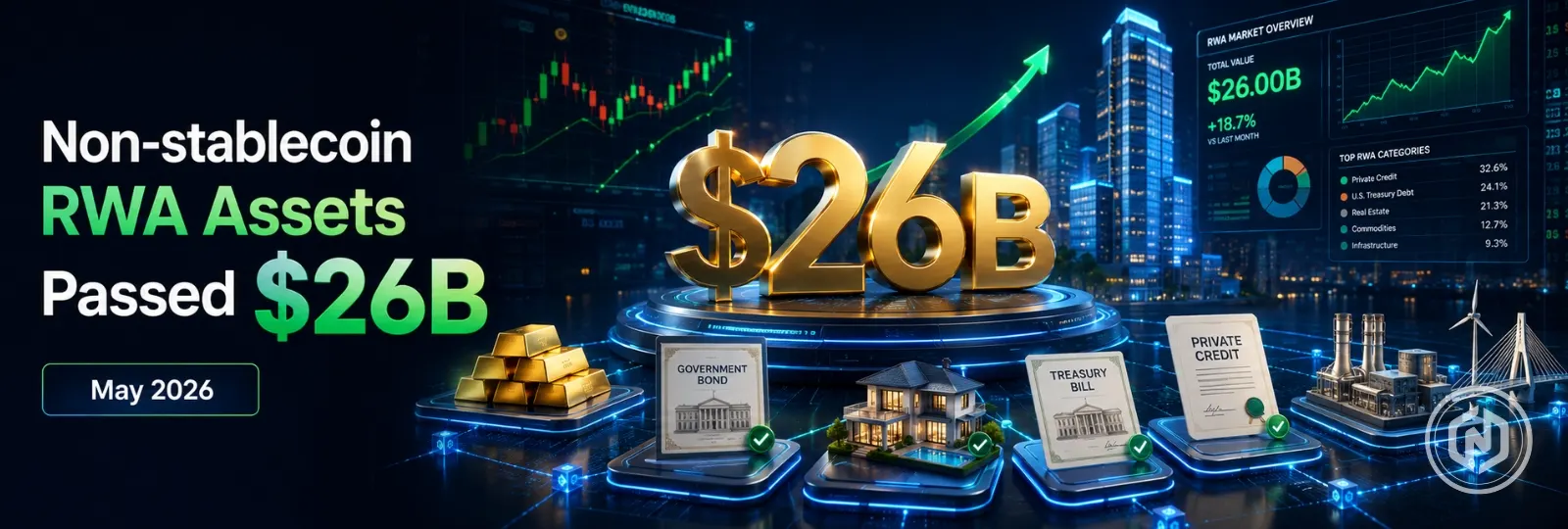
The total distributed asset value of RWAs is currently revolving around $31.37 billion, according to rwa.xyz. This comes after non-stablecoin RWA soared over $26 billion in May. The reason behind the boom in RWAs is the growing popularity of tokenized equities, stocks, treasuries, money market funds, and others among investors.
What are Tokenized Equities?
Tokenized equities are a digital version of stocks linked to public companies, like Tesla or Apple, which are issued on a blockchain.
Instead of buying shares or stocks by using paper records from a traditional broker or any other centralized platform, tokenized equities will allow users to hold a digital token that has the same economic value as those shares. Also, the price of these digital tokens can vary according to the real company shares.
These on-chain assets are working in a very different way than traditional equities. Users can access these tokenized assets by using their crypto wallet. They can access these tokenized equities on DEX or CEX. Also, users can use these tokenized equities as collateral, or they can use them in portfolio management tools.
Size of Tokenized Equity Market
Amid the growing regulatory clarity, the tokenized equity market has witnessed a major jump in 2026. According to the current data on rwa.xyz, the total on-chain distributed value of tokenized equities and ETFs is revolving at around $1.46 billion. This is the major increase from last year, when the total value was around $424 million in mid-2025.
While the total value of tokenized equities is lower than the overall real-world assets (RWAs) market, tokenized equities are rapidly becoming popular among investors who need their uninterrupted access.
Ondo Finance is the leading platform for tokenized stocks as it holds around 65% of the total market share. The platform has surpassed $1 billion in total value locked for tokenized stocks and exchange-traded funds within just a few months after its launch. The platform is currently providing service for more than 260 assets, including Tesla, NVIDIA, Apple, and popular ETFs.
The reason behind the popularity of Ondo Finance is that the platform follows regulatory compliance while providing support to various blockchains, such as Ethereum and Solana. Also, its deep integration with various blockchains is allowing tokenized equities to be used as collateral.
Another major platform in the market is Kraken’s xStocks. It is providing support for more than 100 United States stocks and ETFs on blockchain networks like Solana. These tokens are backed by real-world shares in a 1:1 ratio. The platform holds these tokens at regulated custodians.
What Tokenized Equities Need to Get Mass Adoption
1. Proper Structure
Before accessing tokenized securities, it is important to understand the structure behind them. According to xStocks, the company has called its products a tokenized version of real assets that is backed by a 1:1 ratio. It means that these token holders will receive a tracker certificate; however, it will not give them voting rights as shareholders.
Apart from this, there are secondary markets, such as exchanges where users trade these tokenized equities. They can access these platforms at any time; however, most tokenized stocks follow United States market hours, and this is the major reason these are only available 5 days a week.
In order to verify customers, KYC verification is not enforced directly on the blockchain itself for these tokenized assets. According to xStocks, anyone can technically hold or transfer the tokens on-chain. Instead, KYC checks are handled by exchanges and platforms when users create accounts and access their services.
KYC rules for tokenized assets can vary based on how users access and use them. Activities such as trading, token redemption, custody services, and transfers may follow different compliance requirements depending on the platform and jurisdiction.
For example, BlackRock’s BUIDL, BENJI, and VBILL are tokenized money market funds or Treasury fund shares. These tokenized assets are only developed for institutional investors. That is why there must be proper rules if they are using tokenized assets as collateral on the platform.
Also, while all tokenized assets look the same from the outside, there are many major differences between them once they enter the decentralized finance sector (DeFi).
- There are lending markets that need to decide collateral ratios.
- The platform for perpetual futures contracts needs accurate price feeds from the oracles.
- Decentralized exchanges (DEX) have maintained their market rules according to stock markets, as traditional markets close at night and on weekends. It is important for DEX to get an accurate price feed during the liquidation and when the market stays closed.
2. Cash and Collateral Layer
There is a difference between tokenized stocks and tokenized funds. For example, BlackRock BUIDL, Franklin Templeton Benji, and VanEck are not tokenized stocks; they are tokenized versions of real-world assets. BUIDL is a tokenized money market fund. While BENJI is representing Franklin Templeton for holding fund shares on the blockchain, VBILL is VanEck’s tokenized United States Treasury Fund, which is issued through Securitize.
However, all three of these funds are available on the funding and collateral layer. It is important for tokenized stocks to turn into tradeable tokens into assets that a funding system can use. However, to do that, the market needs more exposure than stocks and ETFs. Apart from this, this ecosystem also needs stablecoins, tools for managing cash, and collateral in order to support trading.
3. Tracking of Real Volume of Trading Capacity
In the digital asset world, the trading volume is the real indicator to check the health of the market. When a tokenized asset issuer launches an asset on the blockchain network, it only means that the issuer has completed the technical process to integrate on that blockchain network.
However, the trading volume is the real sign to find out whether money enters the market. This trading volume could be in the form of the number of users, the number of wallets, and the total value locked (TVL).
The total value locked (TVL) is the measurement of how much money has been deposited into the asset across different platforms. Decentralized exchanges (DEXs) are the number of actual trading activities.
Conclusion
Tokenized equities are quickly turning into one of crypto’s most closely watched sectors, blending the accessibility of blockchain with the familiarity of traditional stocks. But flashy growth alone will not be enough to push the market into the mainstream.
For the sector to scale sustainably, platforms will need clearer regulations, stronger liquidity, accurate pricing systems, and tighter integration between traditional finance and DeFi infrastructure. While regulators are begging to acknowledge the space, concerns around compliance, investor protection, and market structure still remain unresolved.