




ADA, the native token of the Cardano ecosystem, rose 2.53% on Tuesday to trade at $0.174. The buying pressure aligns with a renewed recovery in Bitcoin’s price following the easing of geopolitical tensions in the Middle East. This surge in Cardano price also ignores a hack on the Wanchain bridge, which resulted in 515 million NIGHT drained from the protocol’s treasury.
Cardano Price Rebounds While Futures Traders Hold Back
On Tuesday, July 21, the global crypto market cap bounced roughly 1.19% to reach $2.26 trillion. A primary catalyst for the market rally is growing confidence in the U.S. Clarity Act—a major piece of crypto market regulation—is closer to passing.
Reports indicate that a breakthrough regarding an ethics provision has revived progress on the bill, which aims to divide crypto oversight cleanly between the SEC and CFTC. This has helped raise investor confidence in long-term regulatory predictability.
Following the regulatory optimism from the U.S. legislative progress, the Bitcoin price hit $66,921, and the Cardano price tested an intraday high of $0.1777 amid a 17.25% surge in 24-hour trading volume to $436.37 million. This increase suggests growing conviction from buyers to drive a sustainable surge.
Despite the spot demand, Cardano’s open interest, projecting the total value of outstanding futures and options contracts, remains subdued. According to Coinglass data, ADA OI is wavering close to the $400 million mark. The muted derivatives activity suggests that traders remain cautious despite market recovery, with few new leveraged positions entering the market.
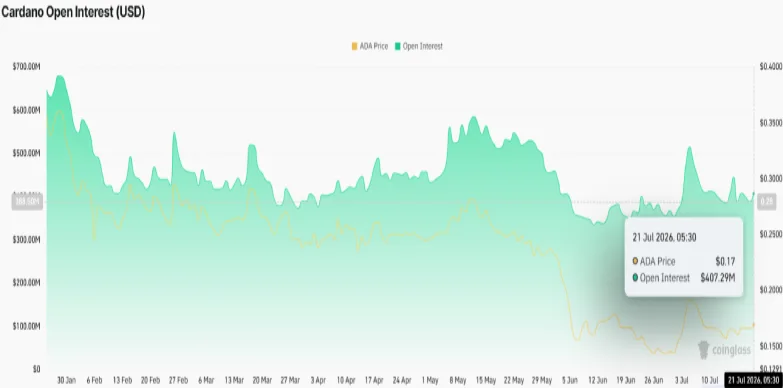
Meanwhile, the Cardano OI-Weighted Funding Rate stands at 0.0046%. The slightly positive funding rate suggests long positions continue to pay shorts, reflecting a modest bullish bias rather than aggressive speculative enthusiasm.
The limited interest in ADA’s derivatives can be attributed to a significant exploit on Wanchain’s Cardano bridge, with attackers draining approximately 515 million NIGHT tokens from the bridge treasury.
BlockSec’s Phalcon team reports the flaw came from non-injective signed-message encoding in the TreasuryCheck validator. The issue arises from raw concatenation of 14 variable-length redeemer fields using the ‘AppendByteString’ fold, without proper delimiters or length prefixes. This defect reportedly lets different field-value tuples generate the same byte string, making it possible for valid signature reuse attacks.
NIGHT is the native currency of Midnight, a privacy-oriented blockchain project developed by the company behind Cardano, Input Output (IO). Following the incident, NIGHT’s price plummeted more than 30% intraday, hitting a record low of around $0.01582. Based on current valuations, the stolen tokens are worth roughly $9 million.
The development has sparked new worries about the security of cross-chain bridges. Wanchain and related teams are likely conducting further investigations. The exploit underscores persistent risks in decentralized finance infrastructure, especially for bridges connecting major networks like Cardano.
Cardano Price Hit Major Rebound Amid Head & Shoulders Formation
Over the past week, Cardano saw a bullish rebound from $0.1575 to $0.174, representing a 10.6% gain. Consequently, the asset’s market cap surged to $6.33B.
Interestingly, this upswing signals the potential formation of a classic reversal pattern called an inverted head and shoulders. The chart setup is characterized by three downswings: the left shoulder, the middle head, and the right shoulder.
If the pattern holds, the ADA price could rebound another 20% and challenge the pattern’s resistance trendline near $0.21. In addition, the relative strength index has climbed to 54, suggesting the market sentiment encourages a future surge in price action.
Therefore, a bullish breakout from the $0.21 resistance will intensify the bullish projection in ADA price and target overhead resistance at $0.235 and $0.289.
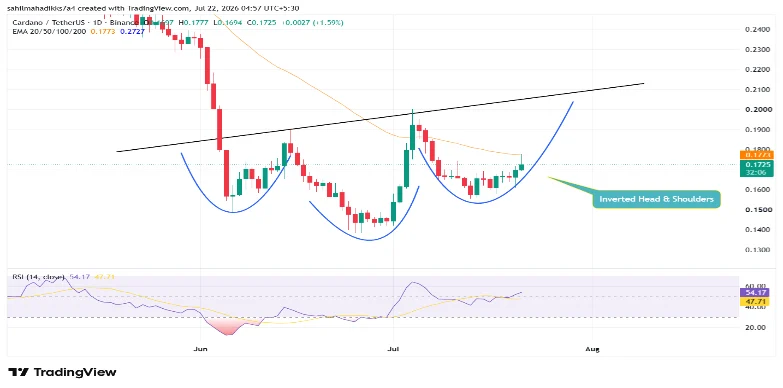
On the other hand, the overhead neckline continued to act as dynamic resistance against the ADA price in the current consolidation trend, suggesting a failed breakout could support a prolonged sideways trend.