




- SharpLink (SBET) is scheduled to enter the Russell 2000 and Russell 3000 indexes during the annual Russell reconstitution on June 29, 2026.
- Easier access to capital markets may allow SharpLink to raise additional funds for further Ethereum accumulation in the future.
- Ethereum price breakdown below the support trendline of the inverted flag pattern signals a potential drop to $1,745.
SharpLink, a leading corporate holder of Ethereum, is set to join the Russell 2000 and 3000 indexes effective June 29, following FTSE Russell’s reconstitution. The move provides substantial institutional visibility and potential passive inflows from the trillions in assets benchmarked against Russell’s U.S. index family, significantly broadening SBET’s shareholder base and capital market access. Here’s how it could potentially impact the ETH price.
SharpLink Joins Russell Indexes With 874K ETH Treasury
The Russell 2000 and Russell 3000 indices are scheduled to include SharpLink (SBET) on June 29, 2026, following FTSE Russell’s preliminary announcement of index changes on May 22, 2026. The company holds about 874,000 ETH, making it one of the biggest corporate Ethereum investors globally, and actively stakes these assets instead of just passively holding them.
The mechanics of Russell reconstitution are straightforward, as passive investment vehicles (index funds, ETFs, and portfolios that are based on the Russell family) are required to include each constituent in its exact ratio. With approximately $12.2 trillion in assets tied to these benchmarks, even a small-cap addition triggers mandatory buying by fund managers with no discretionary leeway. The Russell 2000 specifically tracks smaller domestic companies and carries significant weight as the standard reference point for U.S. small-cap equities. These funds will be buying shares of SBET, not Ether.
Consequently, the knock-on effects on ETH are a step further. The institutional funds that are flowing into SBET are equity investments in an Ethereum-dependent corporate vehicle rather than direct purchases on crypto exchanges. Spot ETH markets won’t feel a mechanical shock the way SBET’s order book will experience around the effective date.
Instead, the long-term dynamic is structural. When an established and publicly listed company has a massive Ethereum treasury, it impacts the way traditional asset managers approach ETH exposure. Investing in SBET can be a gateway to gain exposure in the Ethereum market without the complexities of owning cryptocurrencies, wallets, or dealing with regulatory uncertainty. The trajectory of MicroStrategy and Bitcoin was similar, where stocks started to be viewed as a proxy and pulled in institutional capital that would enter the Bitcoin market.
Furthermore, SharpLink’s improved market visibility could structurally affect its capacity to accumulate more ETH. Index membership tends to lower a company’s cost of capital and simplifies equity raises. If the company chooses to deploy these funds to accumulate more ETH, its overall ecosystem footprint will likely expand.
Ethereum Price Loses Multi-Month Support with this Breakdown
On May 19th, the Ethereum price gave a bearish breakdown below the support trendline of a traditional bearish continuation pattern called an inverted flag. Following the January sell-off, the ETH price managed to ride a steady recovery within the pattern’s two ascending trendlines, which acted as dynamic support and resistance.
However, the pattern is known to recoup the exhausted bearish momentum with this temporary relief rally, which eventually leads to a prolonged correction. Today’s price drop of roughly 1.85% offers a suitable follow-up to the recent breakdown, indicating that the price could drop another 6.5% to hit $1,941 support, and further slip to $1,750.
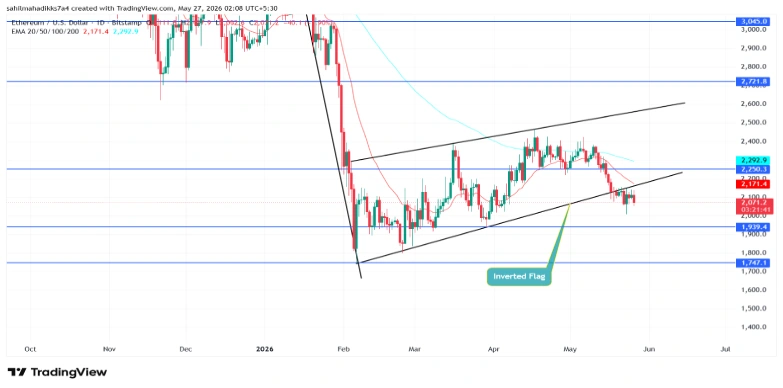
On the contrary, if buyers continue to show resilience above the $2,000 psychological floor, the coin price could enter the channel range again and invalidate the bearish thesis.