



- Pi Network price is getting steady support at $0.1, with open interest falling to $9.98 million, indicating a decrease in speculative demand.
- The risk-off mood swept through the crypto market as geopolitical worries intensified around the new U.S.-Iran conflict.
- Pi network token ownership is still very concentrated, as only 21 wallets own over 10 million tokens each
The native token of the Pi Network ecosystem, Pi, fell by another 8% on Wednesday to reach a new all-time low of $0.1006, briefly rebounding to $0.1028. The PI price had already been under intense selling pressure since Pi2Day 2026, but the renewed geopolitical tension further drove down the price in the downtrend. Concentration risk and open interest declines provide further downside pressure on Pi Network, suggesting potential failure below the $0.1 lowest price limit.
Pi Network Faces Bearish Pressure as Open Interest Slides
On June 8th, the Pi Network price witnessed an intense sell-off which pushed its value to an all-time low of $0.1006, and the market cap dropped to a $1.1 billion low. The pullback aligns with a broader crypto market pullback amid renewed U.S.-Iran conflict. During the NATO summit in Ankara, U.S. President Donald Trump stated that the Memorandum of Understanding (MOU) is over after recent strikes and vessel attacks in the Strait of Hormuz.
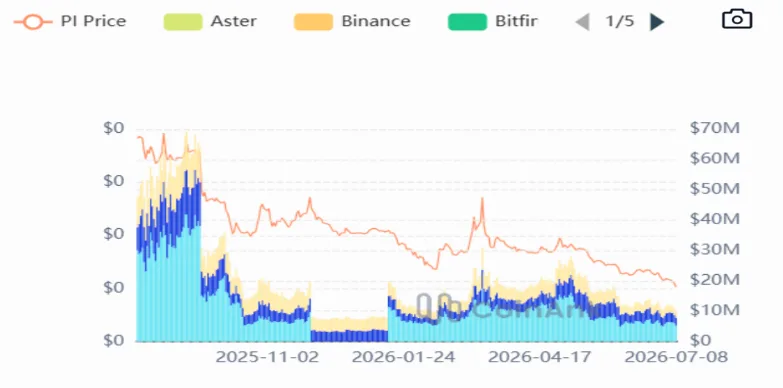
In addition, the Pi Network open interest (OI), projecting the total value of outstanding futures and options contracts, recorded a continued contraction during the price pullback. According to CoinAnk data, PI open interest dropped to $9.99 million on Wednesday, down from $10.88M recorded yesterday. This sudden drop suggests long-positioned players liquidated due to prolonged price correction.
Typically, the declining open interest also suggests unwinding futures positions, reflecting reduced speculative activity and weakening market participation.
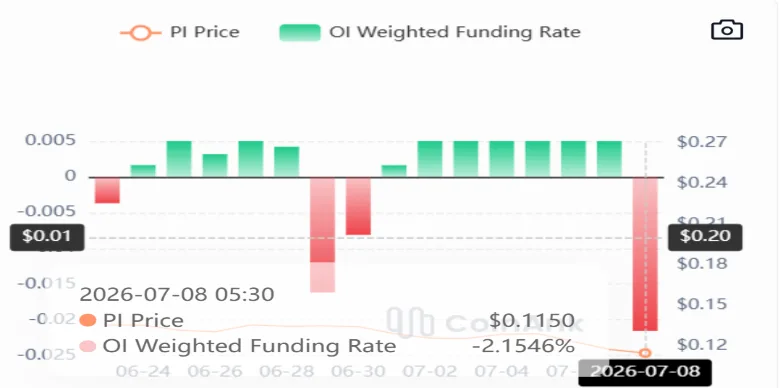
Moreover, PI’s OI Weighted Funding Rate has plummeted to an aggressive -2.1546% region. This indicates strong conviction from sellers for prolonged downfall as they are willing to pay long-positioned traders just to keep their bearish positions open.
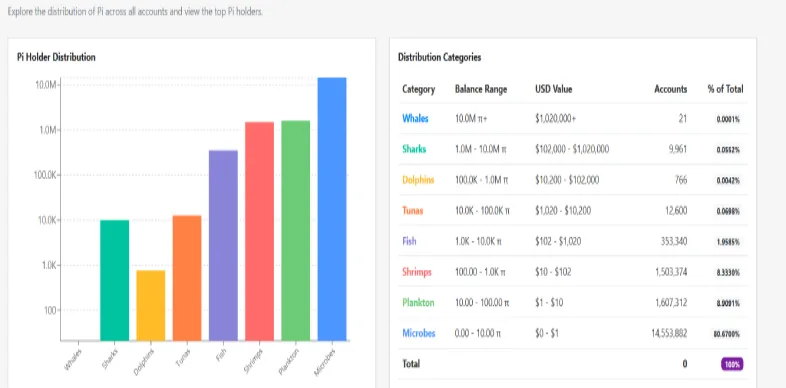
Pi Network’s token distribution is highly concentrated in a few addresses. There are only 21 whale accounts with more than 10 million PI each and 9,961 shark wallets with 1 million to 10 million tokens. There are 766 more wallets in the 100,000 to 1 million PI bracket.
This leaves the vast majority of participants with minimal stakes. More than 14.55 million accounts (or about 80% of the total number of accounts) have 10 or fewer PI. The middle tier of ownership is also relatively light, as many of the remaining wallets are small.
PiScan data indicate that fewer than 10,000 addresses control the overwhelming majority of higher-value token holdings. This imbalance may raise some questions about the decentralization of the network, as a few large holders may have a significant effect on the liquidity, token supply, and governance of the network.
These wallets, if managed by a few entities, can potentially cause greater price fluctuations and manipulation risk if coordinated selling or buying occurs.
Pi Network Price Seeks Support at a Nine-Month-Long Accumulation Zone
With today’s price drop, the Pi Network price returned to a downsloping support trendline, active since October 2025. Despite its downsloping slope, this trendline has acted as a key reversal point for PI buyers during market drops.
The last two times PI coin sought support at this floor, the price rebounded roughly 92.11% and 130% before forming a local top. Thus, the coin price is at a pivot floor, building its momentum for the next major move.
The momentum indicator RSI dropped to the oversold region of 22, mimicking a similar setup seen during the past two bullish rebounds. If history repeats and PI buyers can defend the aforementioned support trendline, the PI coin price could jump 15.5% and challenge $0.1192, followed by a leap to $0.14. Based on the PI coin price prediction, the crypto buyers need to reclaim these floors to fuel further recovery in price.
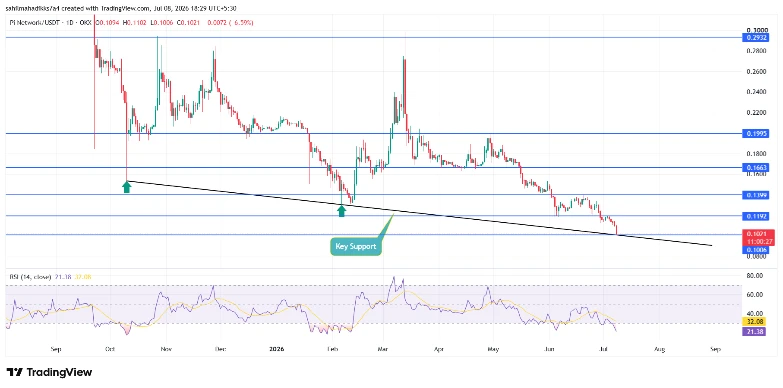
On the contrary, if the Pi Network price loses the support trendline, currently coinciding with the $0.1 psychological level, the bullish thesis will get invalidated, and the sellers could drive a prolonged downfall.