



In 2026, Solana is outperforming the Ethereum blockchain in many real-world metrics despite its strong total value locked (TVL) of around $39.986 billion. This includes transaction speed, transaction costs, etc., which are helping the Solana blockchain beat its biggest competitor in the DeFi sector. The technical upgrades and advancements on the Solana blockchain are making it a perfect choice for new blockchain-based use cases like tokenized real-world assets.
Solana Outperforms Ethereum in Key On-Chain Metrics
1. Daily On-Chain Activities and Transaction Volume
One of the biggest areas where Solana has emerged as a clear winner is on-chain activities, where the network left all other competitors way behind in the race. In the last few months, Solana has processed far more transactions than Ethereum.
As of now, Solana has an average of around 2.9 million daily active addresses, along with 128 million, according to On-chain data. This is way larger than Ethereum’s around 521,000 active addresses and around 2.5 million daily transactions.
In Q1 2026, Solana recorded around 25.3 billion transactions. On the other hand, Ethereum has just recorded approximately 200 million transactions in the same period of time. Based on these statistics, Solana is a clear winner in daily transactions and on-chain activities, thanks to its capability to handle a large number of transactions. From memecoin season to retail trading or payments, Solana has grabbed the attention of DeFi users.
If we talk about transactions per second, Solana has 49 times higher TPS than the Ethereum blockchain. At the time of writing this, the real-time TPS of Solana is 1,723 tx/s, while Ethereum has 34.87 tx/s. In theory, Solana can also achieve 65,000 TPS, which makes it a perfect fit for handling large numbers of transactions.
2. Decentralized Exchange Volumes
Solana has dominated DEX trading volume for extended periods. In Q1 2026, Solana recorded around $210 billion in 30-day decentralized exchange volumes after outshining Ethereum on the daily chart. This DEX volume on Solana was larger than the combined volume of Ethereum Layer 1 and Layer 2 networks, which was around $180 billion. The reason behind the growth in DEX volume is platforms like Jupiter and Raydium, which are attracting a huge amount of crypto traders.
However, the gap between Solana and Ethereum has been reduced in an impressive manner. By May 2026, monthly DEX volumes on both blockchain networks had soared to approximately $45 billion each.
3. Transaction Speeds and Costs
As mentioned earlier, the Solana blockchain network has an impressive throughput, thanks to its monolithic Layer 1 architecture. Solana has approximately 405 ms block times along with sub-cent fees, which allows users to settle their transactions in no time on the network.
On the flip side, Ethereum’s mainnet has very slow speeds with high gas fees in comparison to the Solana blockchain. This is the major reason why many Ethereum users are forced to shift to Layer 2 networks. This introduces various risks such as fragmentation of liquidity, bridging risks, and many more.
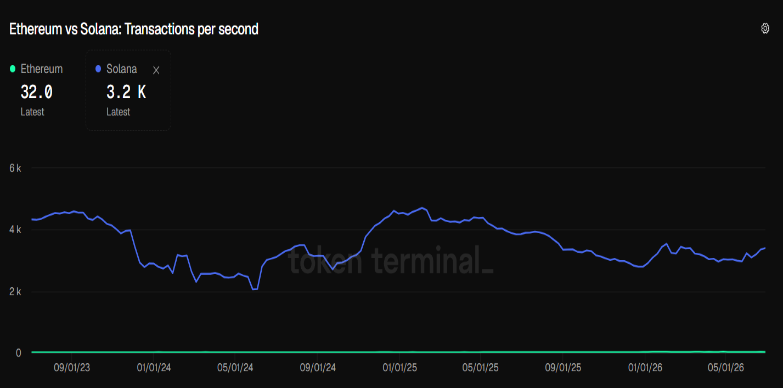
(Source: Token Terminal)
Apart from this, Solana has also achieved hard finality in about 6.4 seconds, which makes it a perfect fit for high-speed applications. While Ethereum’s Layer-2s improve TPS, it could be very difficult for some users to use them due to the complexity associated with them. This includes issues like multiple bridges, gas tokens, and confirmation times. Solana’s single chain is addressing such issues for users by making the overall process simple.
Solana Dominates Tokenized Equities Market with Impressive Trading Volume
Amid the boom in real-world assets (RWAs), Solana has emerged as a leading blockchain network for many financial institutions and companies to roll out tokenized assets. According to rwa.xyz, the distributed asset value of real-world assets on Solana has soared above $3.48 billion with a surge of 36% in the last 30 days. In the last 30 days, it has recorded $8.57 billion in transfer volume. There are around 293,000 RWA holders on the Solana blockchain.
The network has settled a large number of on-chain tokenized equity spot volumes. In the last few months, Backpack Securities, in partnership with Sunrise, has issued major tokenized stocks on the Solana blockchain. This issuance of tokenized equities includes tokenized SpaceX shares, which were launched on the same day as its Nasdaq listing. Tokenized SpaceX shares have surpassed 10,000 on-chain holders and $350 million in cumulative volume on the network.
Apart from this, there are many other tokenized equities launched on the Solana blockchain, including SanDisk, the Roundhill memory chip ETF, and many others. These tokenized stocks are pegged to the underlying shares, which means that traders can redeem tokenized stocks for underlying shares through traditional brokerage platforms. Apart from this, tokenized stocks are also opening doors for fractional ownership.
Backpack has also waived stock trading fees through July 2026 in order to boost the adoption of tokenized stocks. Major financial institutions, such as Securitize, BlackRock, and Franklin Templeton, are also using or exploring Solana for their settlement finality. Apart from this, Solana’s Permissioned Environments are also creating private zones while complying with regulations to boost the adoption of tokenized assets.
The growing adoption of tokenized stocks comes amid the growing regulatory clarity after the SEC issued a statement to clarify their stance on tokenized securities. SEC stated that “A single class of securities could be issued in multiple formats, including tokenized format. Similarly, an issuer may permit security holders to hold a security in different formats and convert the security from one format to another. The format in which a security is issued or the methods by which holders are recorded (e.g., onchain vs. offchain) does not affect application of the federal securities laws.”
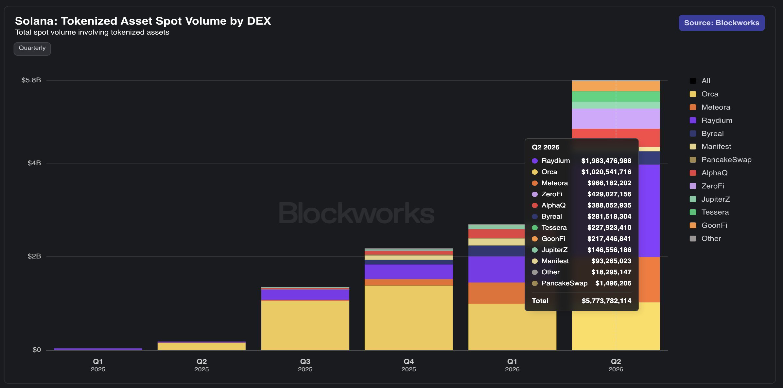
In the second quarter of 2026, Solana witnessed $5.77 billion in tokenized asset spot volume, which is a new quarterly record, according to the official post on X. Solana is responsible for approximately 95% of all tokenized stock or equity trading volume across all blockchains as of June 2026. Amid the growing adoption of tokenized stocks, the tokenized stock volume on Solana is expected to explode in the upcoming years.
On the other hand, Ethereum is still facing internal issues like the departure of senior researchers and executives from the Ethereum Foundation. Apart from this, Ethereum is also facing problems like revenue-related issues, while other blockchains are winning with impressive revenue.
Final Thoughts
While Solana is outperforming Ethereum in many ways, it would be wrong to say that Solana will replace Ethereum in the future. Ethereum is still dominating blue-chip DeFi and institutional custody. On the other hand, Solana is expanding its boundaries with high throughput and on-chain activities, which help it attract real-world use cases.
According to McKinsey’s report, the tokenization market is expected to reach around $2 trillion by 2030. While Solana is already dominating the tokenized securities market, it would put Ethereum behind if the Ethereum community fails to ramp up its efforts to scale the network.