


Key Highlights
- On October 28, Solana rose about 3%, and it is currently trading around $102. It has reclaimed the $100 level, supported by an overall crypto rebound as investors positioned ahead of the Federal Reserve’s policy decision.
- The upward momentum comes after the Alpenglow consensus upgrade, which activated on October 21, 2026, replacing TowerBFT and targeting roughly 150-millisecond finality, down from about 12.8 seconds, while moving validator voting off-chain.
- Despite the gains, headwinds remain, including continued outflows from U.S. spot Solana ETFs and some large wallet movements raising short-term selling concerns.
On October 28, 2026, Solana (SOL) soared about 3%, trading near $102 to $103 after reclaiming the psychologically important $100 level.
The price movement comes amid a broader cryptocurrency rebound as investors positioned ahead of the Federal Reserve’s policy decision later in the day. Bitcoin hovered near $81,000, and Ethereum traded around $2,350. Solana’s market capitalization stood near $60.47 billion, keeping it among the top cryptocurrencies by size, according to CoinGecko.
Solana Gains Upward Momentum Ahead of Fed Announcement
The main factor was market-wide positioning ahead of the Fed announcement. Traders widely expected the central bank to hold rates steady in the 3.75% to 4.00% range, with attention focused on any guidance about future policy. This macro backdrop lifted risk assets, including major cryptocurrencies.
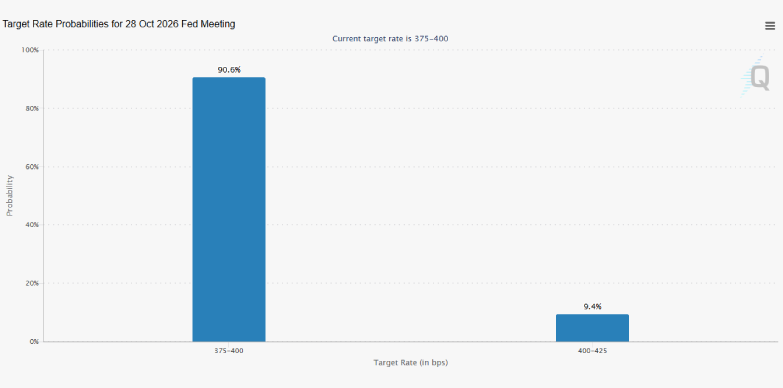
(Source: CME Group)
The upward momentum in Solana also benefited from fresh positive sentiment around its recent network upgrade, Alpenglow. Due to the latest upgrade, ecosystem metrics remained solid. On the Solana blockchain network, decentralized applications are generating impressive weekly revenue and continued interest in tokenized assets on the chain.
Apart from this, institutional activity, including tokenized note issuances, boosted on-chain activity. However, there is still headwind pressure.
According to SoSoValue, U.S. spot Solana ETFs recorded additional outflows in recent sessions, contributing to month-to-date withdrawals. On October 27, the daily net outflow for SOL ETFs recorded around $19.16 million. Some large wallet movements also raised short-term selling concerns. Despite these pressures, SOL outperformed in the daily session relative to its weaker performance earlier in October.
Alpenglow Upgrade Details
The Alpenglow consensus upgrade activated on mainnet on October 21, 2026. It replaced the long-standing TowerBFT system that Solana had used since its 2020 launch. Validators coordinated a live handoff at a specific slot without network downtime.
Alpenglow is expected to enhance transaction finality by roughly 150 milliseconds, down from about 12.8 seconds previously. It uses off-chain validator voting and a more efficient process, freeing block space and lowering costs for validators through a flat admission fee instead of per-vote transaction fees.
Early post-upgrade measurements have shown median finality in the hundreds of milliseconds range under real conditions. The change is mainly viewed as Solana’s most significant consensus improvement since launch. It is designed to make the network feel closer to centralized systems for trading and payments while maintaining decentralization. Further phases of the broader Alpenglow roadmap remain in development.
Solana (SOL) Holds Above Major Support Level at $100
On Wednesday, the overall crypto market witnessed a small rebound ahead of the Fed rate decision. Along with Bitcoin and Ethereum, privacy coins, like Zcash, have experienced a spike on the daily chart due to various macroeconomic factors.
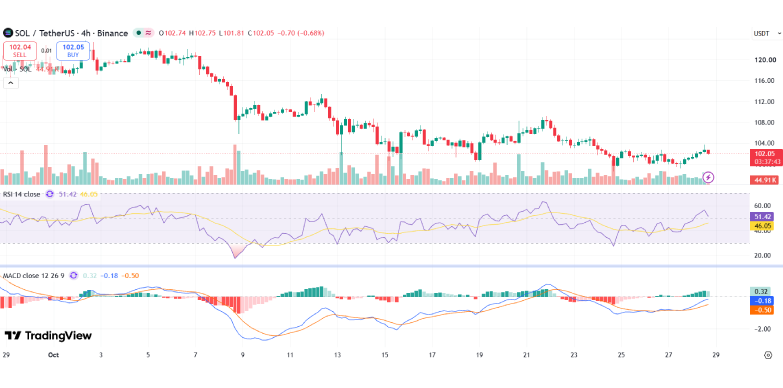
On the daily chart, SOL held above the key $100 support zone that has acted as a floor in recent sessions. Price traded near the daily pivot around 101 to 102, with immediate resistance near 104 to 105. A sustained break above that area could open the path toward the 106 to 110 zone, including shorter-term moving averages.
The Relative Strength Index sat in neutral territory near 48, indicating neither overbought nor oversold conditions. Short-term moving averages remained overhead, reflecting the recent corrective phase, while longer-term averages provided structural support.
Volume accompanied the rebound, consistent with a relief move rather than a high-conviction breakout. A daily close below $99 to $100 would weaken the near-term picture and raise the risk of a deeper test of lower supports. For now, the $100 level remains the important reference point.