




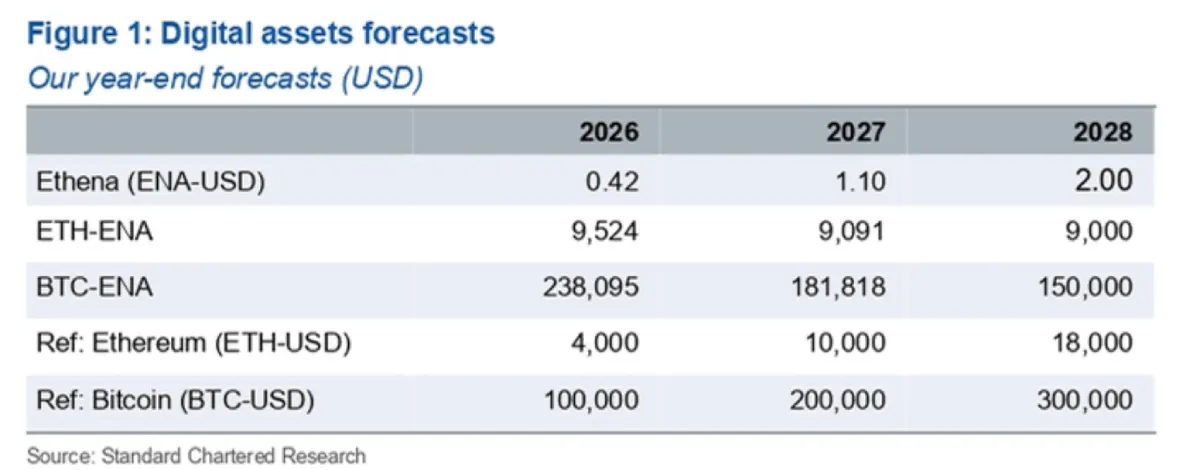
- Standard Chartered projects a multi-year bull market for ENA, with the bank predicting it will reach $0.42 by the end of 2026, $1.10 in 2027, and $2.0 by 2028.
- To sustain a 5.2% APY, the protocol is shifting from basic trades to RWAs, DeFi lending, and T-bill-backed products like USDtb.
- The risks of structural inflation have reduced after an Ethena Foundation buyout ended longstanding schedules of token unlocks for early seed investors.
Standard Chartered has initiated coverage on Ethena (ENA), predicting a significant 7x price surge that could drive the native token to $2.00 by the end of 2028. This bullish stance is supported by analysts noting its main token of the year, USDe, is growing at a quick pace and its structural changes aim to gradually shrink the total number of tokens in circulation.
Core Drivers for Asset Expansion
USDe reached a market cap of $10 billion in just nine months after launching in late 2023, the fastest stablecoin to reach this level. Growth is further amplified by key structural integrations into major institutional platforms, including BlackRock’s Aladdin, Coinbase, and Robinhood.
To build a more resilient, multi-environment yield framework, Ethena is diversifying the collateral behind USDe. Its initial yield was built purely on a crypto-based trade with long spot positions and short perpetual futures, but the protocol has incorporated additional funding sources. These new collateral avenues include:
- DeFi and Institutional Lending: The amount of capital invested in platforms such as Aave, Morpho, and Maple Finance.
- Liquid Stablecoins: Portfolios with yield-generating assets such as PayPal’s PYUSD.
- Real-World Assets (RWAs): Tokenized short-term credit products and Treasury bill funds, notably BlackRock’s BUIDL fund, which backs its newly introduced lower-yield stablecoin variant, USDtb.
The blended yield for these categories is at 5.2%, which gives a baseline to reference as broader tokenized RWAs on blockchains are expected to expand from $40bn to $2t by 2028.
Revenue Reinvestment and Token Dynamics
A significant part of the positive valuation forecast is due to structural changes in the protocol’s valuation of value. Historically, Ethena Foundation has been running schedules of token unlocks that diluted the market share, but recently, it completed a buyout of locked tokens belonging to its major seed investors, thus ending the historical unlocking of tokens. In addition, a newly approved fee switch is in place that creates a framework for 95% of net revenues on all existing and future lines of business to be channeled into a programmatic buyback-and-burn mechanism.
Under this system, the scale of native token repurchases shifts upward alongside USDe’s total supply expansion. At the USDe supply level of $7.5 billion, the net revenue take rate is projected at 5% with an annualized buyback value of $22.5 million. At $25 billion, the take rate would rise to 25%, bringing the annual buyback volume to $375 million. If USDe moves to $40 billion by the end of 2028, the buyback rate should remain around 23%, causing a market contraction of the same order, which would dramatically push token prices higher.
Ethena Whitelabel and Ethena Pay Rollouts
While Ethena is primarily building a stablecoin, it is also expanding its secondary services to create alternative revenue streams for its buyback program:
- Ethena Whitelabel: A stablecoin-as-a-service program that enables third parties and networks to launch their own stablecoins on Ethena, while retaining the yield generation process within the Ethena system.
- Ethena Pay: A mobile banking and payments application built on top of the USDe infrastructure to provide transaction services and better savings rates for retail users than traditional financial products.
Multi-Year Market Forecasts for Ethena Price
The bank’s digital asset research team expects the ENA price to hit $0.42 by the end of 2026, $1.10 by 2027, and the $2.00 mark by 2028. Over the same time period, this growth path is projected to outpace the relative growth of both bitcoin and Ethereum.
But analysts pointed out that achieving these goals will rely on the continued growth of yield-bearing stablecoins that can be backed by non-yielding competitors, as well as the rapid growth of blockchain-based RWA markets to meet the increased collateral needs of Ethena.