





Key Highlights
- After the $387.5M Bitget hack, NEAR Intents rejected $50M+ in attempted flows but froze only $503K ($166K slipped through).
- SHIELD flagged the illicit swaps in real time via KYT data and on-chain intel, blocking most before settlement.
- BGB price analysis projects a classic bullish reversal pattern called an inverted head and shoulder, suggesting a potential target of $2.8 upon completion.
Following the recent $387.5 million Bitget hack, a major point of discussion in the crypto community is why the cross-chain protocol NEAR Intents froze only $503,000 despite intercepting and rejecting over $50 million in hacker-associated flows. For crypto analysts, this vast disparity reveals an intriguing blend of architectural demarcations and structural mindset.
Why NEAR Intents Froze $503K out of $50M Detected
The stark difference between the $50 million flagged and the $503,000 frozen boils down to how cross-chain intent protocols handle risk deterrence:
- Attempted vs. Executed Volume: The $50 million figure refers to attempted flows–The hackers attempted to conduct tens of millions worth of swaps with NEAR Intents. But, since the system detected these trades early on, the majority of these trades were rejected prior to execution.
- Diversion to Other Platforms: Once NEAR Intents rejected the $50+ million in illicit transactions, the attackers were forced to route those funds to other cross-chain bridges and swap providers. NEAR Intents only had physical jurisdiction to freeze funds that were actively caught in mid-transaction within their own architecture.
- The Final Tally:
- $50M+ in laundering flows successfully stopped/rejected.
- $503K frozen mid-execution (currently restricted pending legal procedures).
- $166K unfortunately slipped through before the blocks were completely deployed.
The Technology: How it was Flagged
NEAR Intent’s own proprietary risk mitigation system called the SHIELD system drove the interception.
- SHIELD constantly monitors for abnormal cross-chain transaction flows.
- It brings together live security data from various Know Your Transaction (KYT) infrastructure providers, on-chain intelligence networks, and independent research organizations.
- SHIELD will slow down or even block the execution if the transaction includes addresses that are associated with the Bitget breach.
In addition to the technical arrangements, this event has sparked a fierce ideological battle in the Web3 space over the meaning of permissionless infrastructure. Critics argue that selectively blocking addresses violates the core tenets of censorship resistance, comparing NEAR Intents’ intervention to traditional finance.
However, Bitget’s own executive leadership has pushed back aggressively against this narrative. In a public statement on X, Bitget CEO Gracy Chen lauded the intervention, stating, “This is what permissionless but not ‘facilitating known stolen funds’ should look like.” Chen argued that public blockchains do not have to choose between total openness and actively protecting users from hackers, adding a definitive industry challenge: “More protocols should take notes.”
BGB Token Holds Bullish Pattern Despite Bitget Hack
Following the Bitget hack on September 24th, the BGB token price has remained sideways, trading within a narrow range of $1.95 to $2.04. The daily candle chart shows long-wick rejection candles on either side, indicating that market participants remain uncertain about the asset, as the stolen funds have not yet been recovered.
Despite the recent volatility, the BGB price holds above the 50-day exponential moving average— a trend-following indicator that shows the strength or weakness of current price action compared to the average trend of the asset.
With the 50-day EMA projecting near-term bullishness, the BGB also retails a classic reversal pattern called an inverted head and shoulders, as showcased in the chart below. The chart setup is characterised by three troughs: left shoulder, middle head, and right shoulder, suggesting strong demand pressure from below.
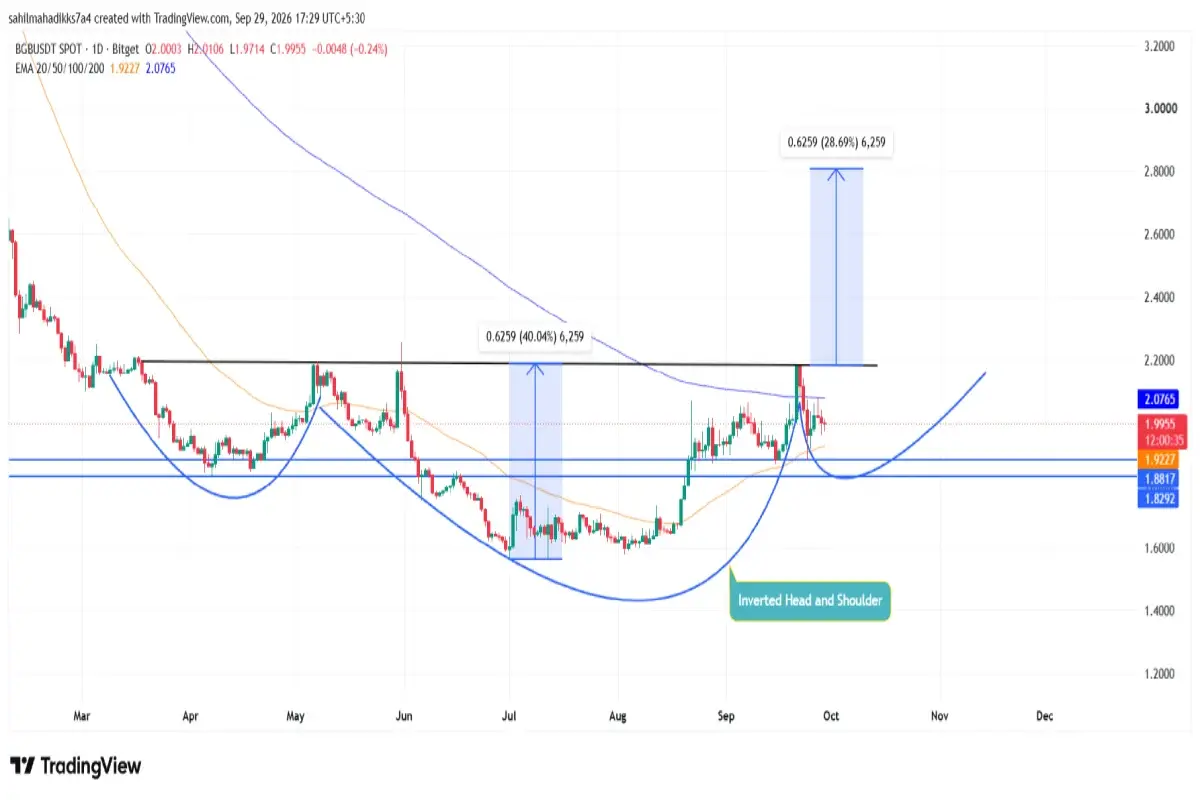
If the BGB buyers could protect the potential base support of the right shoulder at $1.88 and $1.82, the token price could eventually attempt to reach $2.18 neckline resistance. A bullish breakout from this barrier will complete the pattern and set BGB token to chase $2.8.
On the contrary, a price breakdown below the $1.82 support could weakness the bullish pattern thesis.