




Key Highlights:
- Pi Network joined the Open USD partner roster alongside financial giants.
- The alliance integrates the project into multi-chain institutional payment networks.
- The PI resonates with a narrow range of inverted flag patterns, signalling a risk of deeper price correction.
The Pi Network has been officially included in the public directory of cooperative partners for Open USD (OUSD). Managed by the Open Finance consortium Open Standard, this is a cross-industry play over infrastructure that seeks to create low-cost, borderless digital settlements on a global scale.
The inclusion links the mobile blockchain project to the alphabetical partner directory on the organization’s official domain, directly alongside global payment networks, standard banks, and native Web3 networks.
Pi Network Enters Elite Financial Network with Tech Giants
One of the most distinguishing aspects of Open USD is the backing that it has received from the major traditional financial institutions and internet technology giants. The Open Standard, with input from more than 140 early partner companies such as Stripe, Visa, Mastercard, BlackRock, Coinbase and Google, created the framework.
In contrast to the legacy stablecoin model, which leaves the interest from cash reserves with a single private company, Open Standard is a utility that is owned by its members. The consortium’s structural “earn by default” model provides dividends to ecosystem nodes and commercial partners based on the number of transactions for the existing reserve as a function of a baseline management fee. Enterprise users can mint and redeem OUSD without volume requirements and extra transaction fees.
Cross-Chain Structural Framework
Open USD is technically designed to operate on several high-throughput blockchain networks and not just one. The first framework deployments will be across well-known L1s like Solana and Stellar, along with scalable L2s like Polygon and Base.
The move puts Pi Network into an ecosystem designed to enable card issuance, spend management for businesses, and smooth enterprise money transfer. The underlying reserves supporting OUSD are completely backed by liquid cash deposits and short-term US Treasury bills and meet conservative requirements for corporate adoption.
Social Media Buzz Mounts as Project Directory Expands
Following the release of the update, community trackers on social media platforms such as X shared the alphabetical index page, placing Pi Network in front of a group of cryptocurrencies such as PayPay Corporation, Pathward, and Polygon.
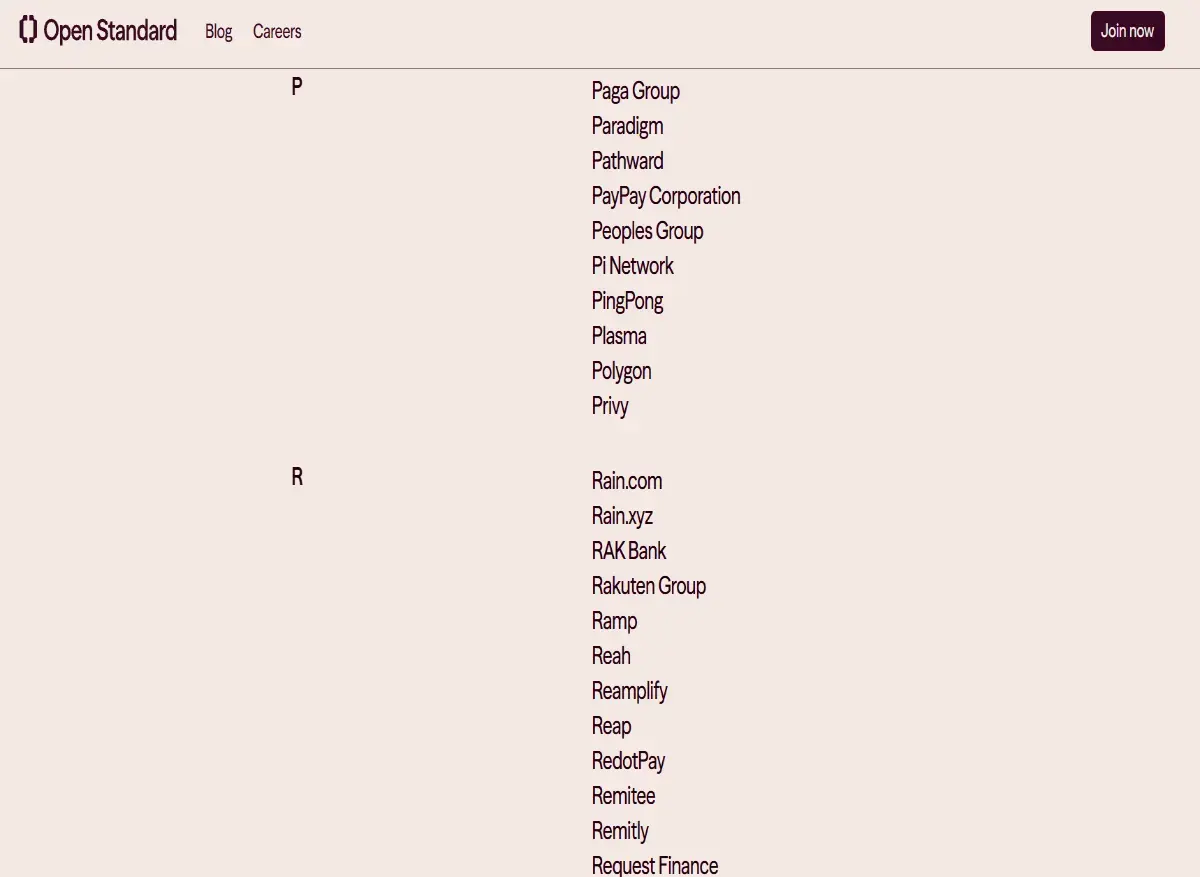
The listing appears on the official Open Standard Partner Page, but the Pi Network core team has not yet released an independent technical brief on the key characteristics of their alignment. This follows the rollout plan of Open Standard, where they are continuously adding new entries to their infrastructure directory as the OUSD asset moves towards a broad public network deployment.
Pi Price Sees Slow Recovery Within Inverted Flag Pattern
Following Pi Network’s entry among the key partners of Open Standard, the PI price records a notable intraday spike of 1.42% to reach $0.091. Subsequently, the asset’s market capitalization also hit $1.03B.
The intraday gain has pushed PI toward its 20-day and 50-day EMAs on the daily chart. Reclaiming this EMAs could bolster the short-term recovery momentum in price and bolster PI token’s chase of key resistance near $0.13.
However, a look at the broader technical chart shows that PI price has been resonating within a fixed channel of an inverted flag pattern. This bearish continuation pattern drives a slow, temporary recovery in price before sellers regain the prevailing bearish momentum.
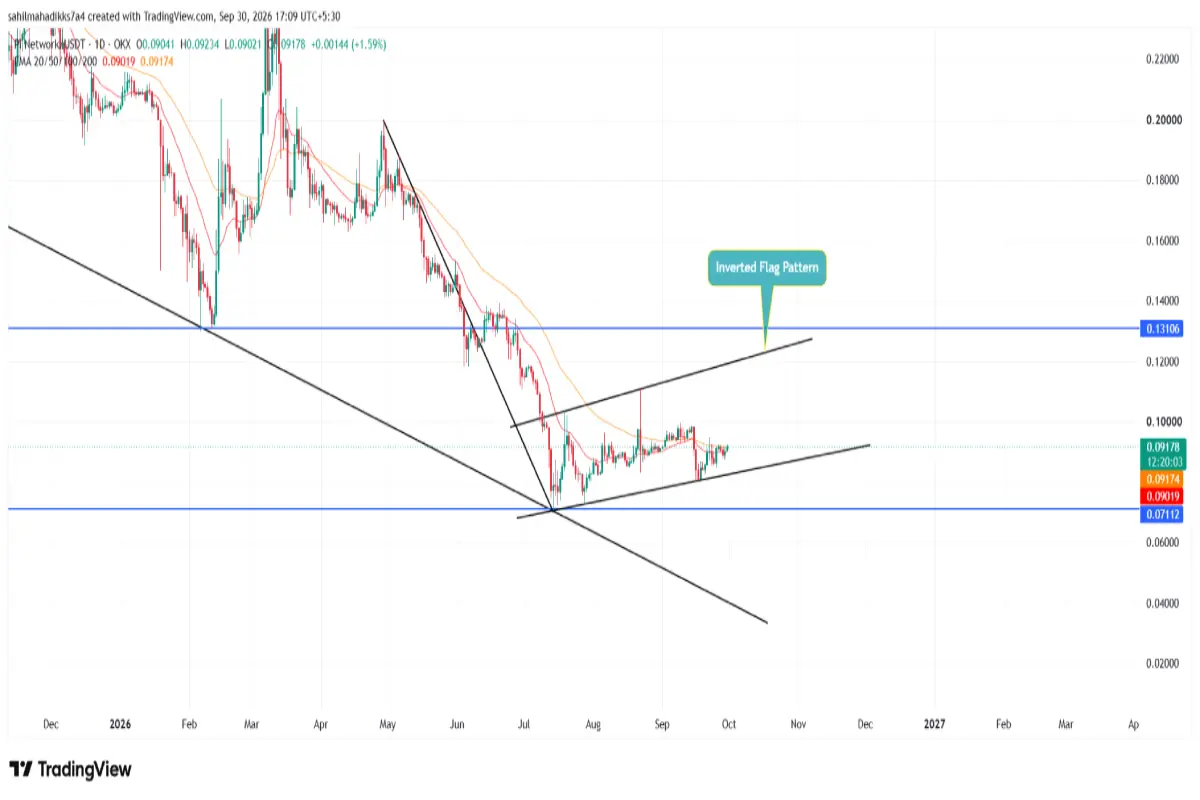
A potential breakdown below the pattern’s bottom support, as shown in the above chart, could invalidate the bullish thesis and extend a deeper correction in PI.