


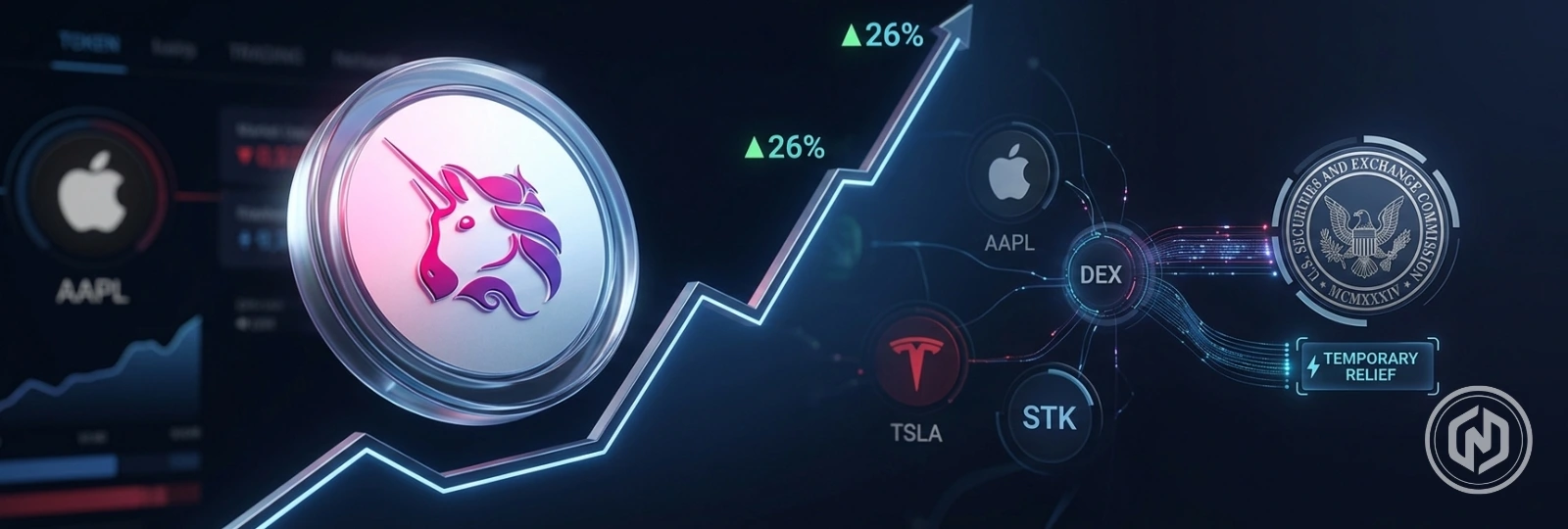


Uniswap’s local token UNI has come out as one of the day’s strongest performers after the U.S. Security and Exchange Commission (SEC) granted temporary conditional relief allowing some tokenized security venues to trade tokenized NMS stocks through permissioned automated market makers and liquidity pools.
UNI, Uniswap’s native token, has surged significantly after this announcement was made public. The SEC decision has become a major mechanism across the tokenized asset sector, with market participants focusing on the potential for Uniswap P4 infrastructure to support compliant on-chain stock trading in the United States.
SEC Decision Puts Uniswap and Tokenized Stocks in Focus
The SEC issued an order granting non-permanent, conditional relief to tokenized securities venues from the definition of exchange under the Exchange Act. The relief applies to trading tokenized NMS stocks through innovative permissioned automated market makers and liquidity pools.
The decision has garnered attention to Uniswap because the exemption covers permissioned pools on Uniswap v4. Hayden Adams, founder of Uniswap, said that the relief also applies to permissioned pools on the protocol’s newest version.
UNI has risen sharply subsequent to the announcement. At the time of writing, the token is up by 27.6% today in the wider move, with the price trading at $8.77, as per CoinGecko. ONDO has gained, rising 12% to around $0.38. SEC action could provide a route for compliant on-chain trading of tokenized U.S. stocks, where permission infrastructure is necessitated.
This differentiation is important because permissioned pools can impose the access and compliance conditions needed for regulated assets and users. The most bullish signal is not only the SEC’s official order, but also a comment from SEC Commissioner Hester Peirce.
Her comments stated that truly decentralized systems driven by sovereign software do not need an exemption, referring to normal permissionless Uniswap-style systems.
This creates two paths for AMM infrastructure: permissionless decentralized systems may operate without the exemption described in the SEC order, while permissioned pools can provide a blueprint for regulated securities trading where additional restrictions are necessitated.
The development has pushed scrutiny about how AMMs could be used beyond cryptocurrency markets. Permissioned stock pools using Uniswap-style infrastructure could potentially allow equities to trade 24/7 while using programmable liquidity. However, the UNI surge does not mean that the Uniswap token itself will capture economic value from tokenized stock adoption.
UNI Faces a New Catalyst but Value Capture Remains Key
The instant market reaction has been optimistic , but the longer-term importance for UNI relies on how the infrastructure is eventually used and whether that activity generates economic value for the protocol.
One key indication emphasized is the probability that a regulated U.S. venue could eventually launch a tokenized-stock pool using Uniswap infrastructure and direct fees or other economic value back to the protocol.
If such a structure develops, Uniswap could probably play a role in governed capital-market infrastructure rather than being used only for crypto-centric assets. This is a potential major driving force for UNI, while also noting that protocol adoption by itself does not automatically create value for the token.
Onchain activity is also garnering attention. Wintermute, described as UNI’s market maker, is allegedly making big onchain transfers. Wintermute has been depositing significant amounts of UNI from exchange hot wallets, including those associated with Coinbase, OKX, MEXC and Bitget, to a Wintermute Binance deposit address.
The SEC development is affecting other tokens connected to the wider tokenized-asset narrative. ONDO has risen 12% to $0.38, while NEAR has climbed 18% to $3.00 following a separate development involving Confidential Intents TVL crossing $70 million and triggering its milestone distribution.
Paul Barron described the decision as a validation of the AMM model for governed securities and identified UNI as a potential beneficiary. The infrastructure adoption would need to translate into economic value for UNI for the development to become a more direct token catalyst.
The next major indication would therefore be a regulated U.S. venue actually launching a tokenized-stock pool using Uniswap infrastructure. Whether such a pool eventually directs fees or other economic value back to the protocol remains an open question.
For now, the SEC’s temporary exemption has placed Uniswap and permissioned AMMs at the center of the tokenized-stock discussion, while UNI’s price response shows that traders are paying close attention to the probable expansion of onchain market infrastructure into regulated securities.