


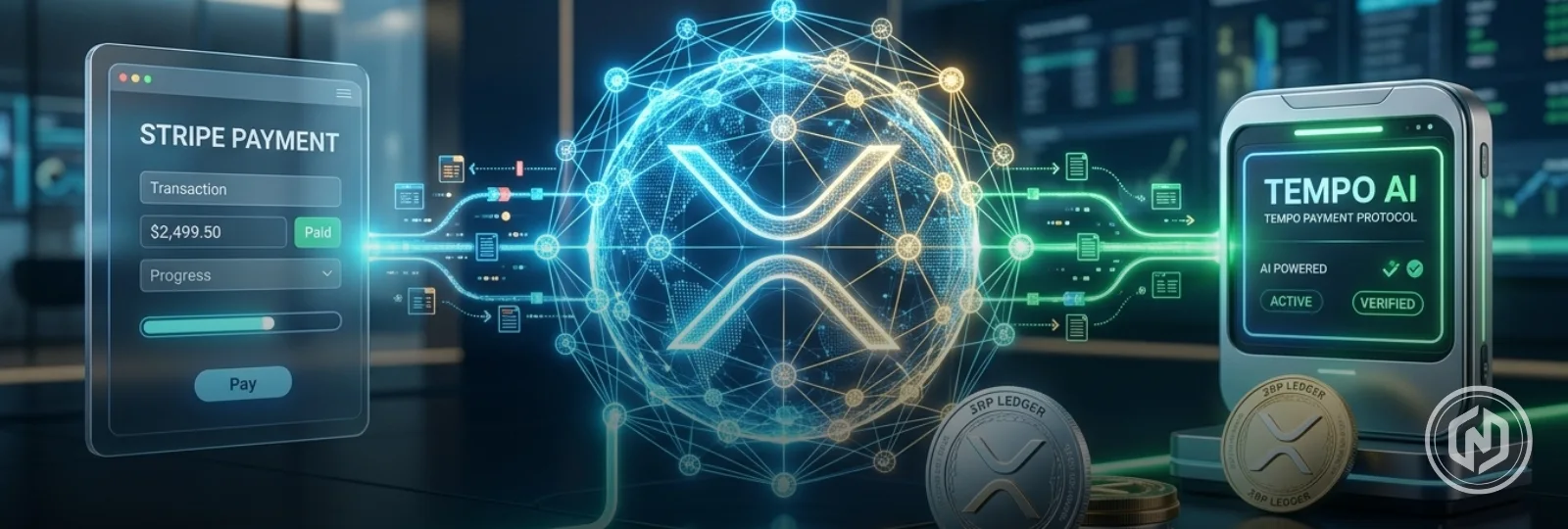


Ripple has updated its XRP Ledger AI Starter Kit to support the Machine Payments Protocol, an open payment standard co-authored by Stripe and blockchain network Tempo for transactions between AI agents and online services. Version 1.1 of the XRPL AI Starter Kit adds MPP support alongside the Open Wallet Standard, allowing developers to build applications in which AI agents can make payments through the XRP Ledger.
The update supports XRP for single and session payments, while RLUSD and other issued assets can be used for eligible single transactions. The release is aimed at developers building applications that allow software agents to pay for APIs, data, computing resources and other digital services. The integration does not mean XRP has been added to Stripe’s regular payment products; instead, XRPL is now supported as a settlement option within the open MPP standard.
Ripple Adds XRPL Support To Machine Payments Protocol
RippleX released version 1.1 of the XRPL AI Starter Kit with support for MPP, adding the XRP Ledger to a payment standard developed by Stripe and Tempo. According to the RippleX developer announcement, MPP allows a service to return an HTTP 402 payment request to an AI agent, after which the agent can authorize payment and receive the requested resource.
The update supports two payment modes through XRPL. For individual charges, developers can use XRP, issued tokens and other supported assets. XRP can also be used for session payments through XRPL Payment Channels, where an agent can make repeated payments while using a service without recording every individual payment directly on the ledger. RippleX said the payment-channel approach allows payment claims to be signed off-chain before the accumulated amount is settled.
The toolkit also adds support for the Open Wallet Standard, which provides a common interface for software to interact with wallets across different blockchain networks. RippleX said the standard can allow agents to request transactions without directly handling private keys, while developers can apply controls such as spending limits and approved destinations.
The release follows Ripple’s June launch of the XRPL AI Starter Kit, which initially focused on X402-based payments using XRP and RLUSD. The latest update adds MPP alongside that existing support rather than replacing it.
The MandoCT post describes the MPP integration as a development for XRP, while other posts supplied by the manager discuss the update and its potential use for AI-agent payments.
For now, the software remains in beta. Ripple’s developer documentation does not identify commercial customers using the new MPP integration or provide transaction volumes associated with it. That means the release represents developer infrastructure being made available rather than evidence of widespread commercial use.
AI Agents Can Use XRP For Automated Digital Service Payments
MPP is designed around a relatively simple payment process. An AI agent can request a resource from a service, API or other internet-accessible endpoint. The service can respond with a payment request, and the agent can authorize the required transaction before receiving the resource.
Stripe introduced MPP with Tempo in March as an open standard intended to let software agents make payments programmatically. The Stripe announcement describes MPP as a way for agents and services to coordinate payments without requiring the agent to follow a conventional account and checkout process. Stripe’s current machine payments documentation lists use cases including API calls, data and other services.
The addition of XRPL gives developers using MPP another settlement network to consider. For a single payment, an agent can use XRP or supported issued assets such as RLUSD. XRP is also currently used for XRPL Payment Channels, which can support repeated payments during a service session. RippleX said stablecoin support for those payment channels depends on a proposed future XRPL upgrade.
The distinction between XRP and RLUSD is relevant because they serve different roles in the current implementation. XRP can be used for both individual payments and payment-channel sessions, while RLUSD is currently supported for single payments. The RippleX documentation says future changes could extend stablecoin support to payment channels.
The wider significance remains dependent on developer adoption and whether applications built around MPP move into broader commercial use. For now, the release adds XRPL support to an existing machine-payment standard and gives developers another option for handling automated payments between AI agents and digital services.