


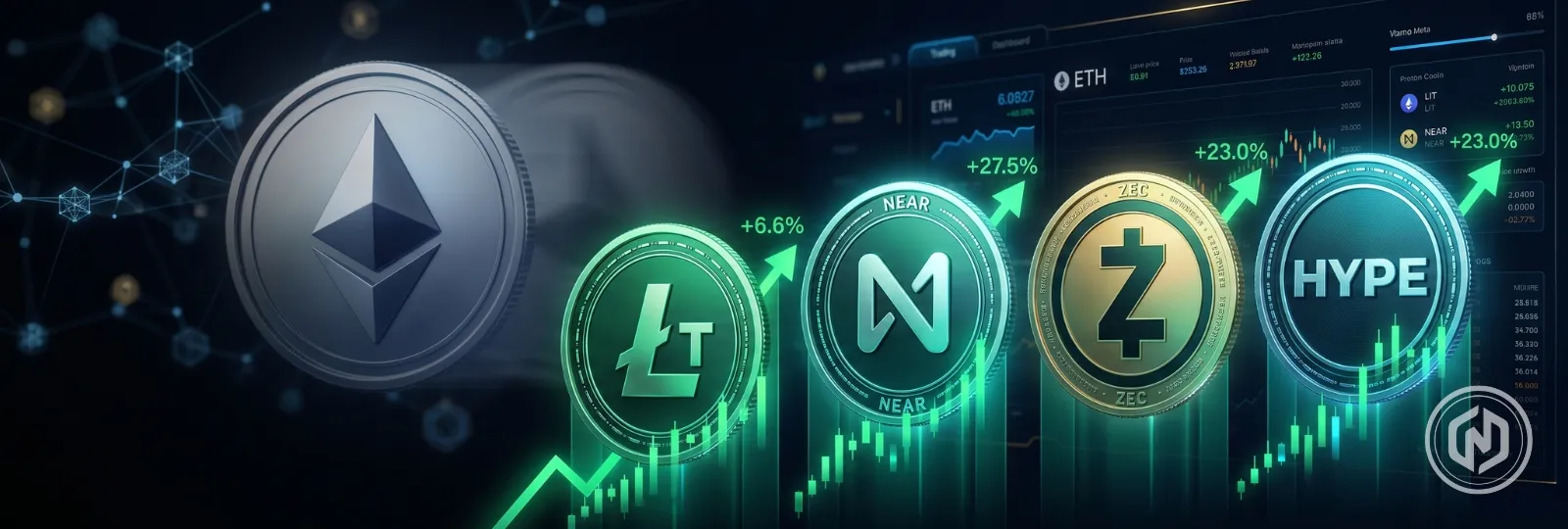


Four tokens that Bankless co-founder David Hoffman added after selling his remaining Ether (ETH) position in May are now trading more than 100% above the approximate entry prices used in a recent market comparison. Lighter’s LIT is up about 293%, while NEAR has gained 223%, Zcash’s ZEC is up 173% and Hyperliquid’s HYPE has risen 106%, according to figures published on September 24.
The comparison uses publicly disclosed or estimated entry prices and later market prices, rather than verified records of Hoffman’s complete personal returns. Hoffman sold his remaining ETH on May 21 and later disclosed a portfolio containing VVV, NEAR, ZEC, HYPE and LIT.
The latest figures therefore show how those tokens have moved from the stated entry levels, but they do not establish how much money Hoffman ultimately made or whether he still holds each position.
Hoffman’s Portfolio Shifted From ETH To Five Tokens
Hoffman disclosed on May 21 that he had sold his remaining ETH, ending a personal position he had held while building Bankless around Ethereum. In a May 26 explanation published by Bankless, Hoffman said his decision was based on his view that the “ETH is money” thesis had already played out, while stressing that he remained positive about Ethereum as a network.
In June, Hoffman disclosed positions in VVV, NEAR, ZEC, HYPE and LIT. Earlier half of the capital was allocated across VVV, NEAR, ZEC and HYPE, with the remaining portion directed into LIT over time.
Publicly disclosed entry prices included about $1.40 for NEAR, $560 for ZEC, $45 for HYPE and $1.35 for LIT. No specific VVV entry price was disclosed.
A September 24 comparison attributed to on-chain analyst Ai Yi used those entry figures to measure subsequent price changes. LIT was the largest move at about 293%, followed by NEAR at 223%, ZEC at 173% and HYPE at 106%. The figures refer to token price changes from the comparison’s entry points, not confirmed returns on Hoffman’s individual trades.
The distinction matters because a public entry price does not reveal the exact size of each purchase, execution prices across multiple transactions, fees, taxes or whether any tokens were later sold. VVV is also left out of the four-token percentage comparison because its specific entry price was not publicly disclosed.
The Price Comparison Does Not Equal A Verified Portfolio Return
Earlier estimates also placed the overall five-token portfolio at roughly 90% to 120% above its approximate entry levels, compared with an estimated 17% gain for ETH over the same period. These calculations were based on public entry-price disclosures and market prices, rather than a complete transaction history.
This limitation has been noted in coverage of the trade. A report described the 90%-to-120% range as an estimate derived from simple price comparisons. A tweet by BlockBeats likewise calculated individual gains from the disclosed entry prices and excluded VVV from the same calculation because its entry price was unavailable.
Hoffman has continued discussing ZEC and NEAR. On September 24, he said ZEC was showing similarities to Ethereum’s 2021 market position and argued that NEAR was emerging as a focal point for smart-contract capital. Those are Hoffman’s market views rather than independently established outcomes.
Community discussion after his May ETH sale also showed a range of reactions. A Reddit discussion included users interpreting the sale as a possible market signal, while others treated it as a personal portfolio decision. Such posts provide context on how the move was received but do not establish the reasons for later token price changes. The current figures therefore document a difference between the disclosed entry levels and September 24 market prices. They do not, on their own, establish Hoffman’s realized profits, current holdings or future performance.