


Key Highlights:
- BNB Smart Chain deployed a new Payment Lane update that automatically reserves 5% of block gas limits for eligible payment transactions.
- The token contracts should be approved by governance for transactions to pass through the BNB Payment Lane.
- BNB price is under heavy selling pressure at the $759 price level amid a bearish head and shoulders pattern formation.
BNB Smart Chain (BSC) has rolled out the Jenner hard fork on its testnet, marking structural changes to the network to allocate network resources through BEP-703 (Payment Lane). The protocol adjustment introduces a new rule to be applied to the gas counter during block validation to isolate a default of 5% of each block’s gas limit in order to qualify payment operations. The network governance still holds the right to change this reservation ratio up to a 10% protocol maximum.
Isolated Gas Accounting Rules
Unused reserved capacity sits idle to ensure priority access when traffic surges and can’t be switched to traffic volume. In case of a hypothetical baseline block gas limit of 100 million, the allocation rules operate under three distinct states:
- Standard Allocation: 5 million gas is allocated to the payment class, and the remaining 95 million gas is available to general traffic.
- Low Payment Demand: If eligible payments use only 2 million gas, the remaining 3 million gas remains completely unassigned. The general traffic capacity still cannot exceed 95 million gas.
- High Payment Demand: When payments spike into 8 million gas, they fill up the entire 5 million reservation and begin to contest the remaining free gas space under the current fee logic, reducing the gas space available for other transactions to 92 million gas.
Technical Access and Validation Framework
The transaction must meet specific structural requirements to go into the Payment Lane. The protocol recognizes two explicit entry pathways:
- Native Token Transfers: Non-zero BNB transfers sent to accounts with zero underlying code.
- Listed Payment Contracts: Interactions sent directly to contract addresses approved on a governance-managed payment index, which starts entirely empty.
Qualifying operations include only transaction types 0x00, 0x01, and 0x02 and must not include system transactions. On the other hand, the following contract creation, blob transactions, and type 0x04 executions are not included. Any transaction that passes through an unlisted intermediate router will not be eligible, no matter what the final destination is.
Validator nodes validate these asset ratios as they perform the block execution task. When using BEP-675’s SendBidBlock framework, this check executes on post-broadcast local import, automatically rejecting any block that has a gas usage less than the minimum threshold as per the builder-revocation protocol.
BNB Price Risk $700 Breakdown Amid Head and Shoulders (H&S) Pattern
Despite the Jenner hard fork activation on BSC testnet, the BNB price tumbled 8.08% on Thursday, dropping to $698.5. Bouncing off key dynamic support at the 200-day EMA, BNB edged up 0.8% today to hold around $704.45.
However, the pullback already triggered a major breakdown below the neckline support ($705.8) of a head-and-shoulders pattern, as shown in the chart below.
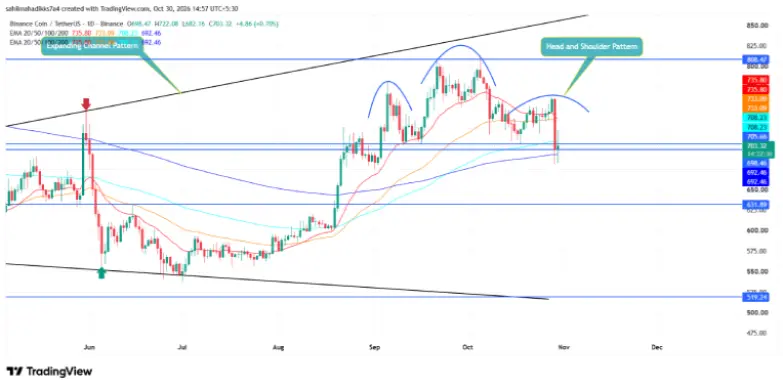
The chart setup is characterized by three peaks: the left shoulder, middle head, and right shoulder, indicating several failed breakout attempts from buyers. That chart is commonly spotted at the local top, signaling a potential change in market trend.
If the pattern holds true, Binance Coin could retain this breakdown and drop another 10% and hit the next significant support of $632.
The relative strength index indicator dipped below the 50% midline, suggesting increasing bearish momentum in price.
On the contrary note, if the buyers manage to retake the $705 floor during a retest, the BNB price will enter a potential consolidation trend to build sufficient momentum for a reversal.