



Key Highlights
- Ethereum NFT marketplace Blur has announced a permanent shutdown of the website frontend on 12th November, 2026.
- The native governance token BLUR fell more than 20% after the announcement, dropping to near an all-time low of $0.015.
- Blend, Blur’s peer-to-peer lending protocol, will cease loan matching on November 12, leaving active borrowers to settle their debts or be liquidated.
The native governance token BLUR crashed by roughly 36% following a recent announcement from Blur on October 12, 2026, revealing that it will permanently discontinue its website frontend on November 12, 2026. The strategic wind-down signifies the end of an era for the platform, which once aggressively dominated the Ethereum non-fungible token (NFT) space.
Strategic Pivot to a “Soft Shutdown”
The official announcement on the social media platform X notes that the upcoming deprecation is for the user-facing Blur Website only. The underlying smart contracts will remain fully functional on-chain while the BLUR token holders will maintain control over the protocol’s internal fee switch.
But more than 99% of all retail users navigate the marketplace only via the graphical Web interface, so the move is being interpreted by the market as a functional “soft shutdown” of the marketplace.
Compounding the ecosystem’s retreat, Blur’s peer-to-peer collateralized lending service, Blend, will completely halt matching new loans on the same November 12 deadline. Active borrowers will be at risk of liquidation if they do not manually pay off outstanding balances before the frontend closure.
The Web3 community has rushed to create alternative lending options, such as OTC refinancing, to avoid the catastrophic debt liquidation of premium blue-chip assets like Bored Ape Yacht Club (BAYC).
A 99.5% Collapse in Trading Volume
Blur’s debut came in October of 2022, with some bold features that made headlines: revenue-free buildings, pro-trader-focused optimization toolsets, and extremely speculative airdrop rewards. By March 2023, the protocol had outstripped its rival legacy marketplace OpenSea by securing a massive 68% of the market share and making a record $1.43 billion in transactions per month.
Although it received billions in raw historical trade volume, Blur’s decision to make the zero-fee model a permanent part of their business model resulted in a lack of meaningful operational protocol revenues. The monthly trading volume on Blur has continued to decline over time, dropping below $7 million by early 2026, representing a decrease of over 99% from its peak.
Mixed Reactions Across the Web3 Community
Blur is undergoing its structural wind-down just 10 days after its Layer-2 scaling solution, Blast, declared its own economic demise. Following the announcement, the BLUR token nose-dived to trade near an all-time low of $0.01226.
While investors were in a panic, many crypto creators and artists were openly cheering on the closure. The feature of optional creator royalties, which critics say had damaged sustainable creator monetization models on Web3, faced heavy criticism from Blur.
The security community is urging blockchain users to revoke permissions of old marketplace contracts. Many abandoned or unused websites are easy targets for decentralized phishing, and having leftover approvals will put wallets at risk.
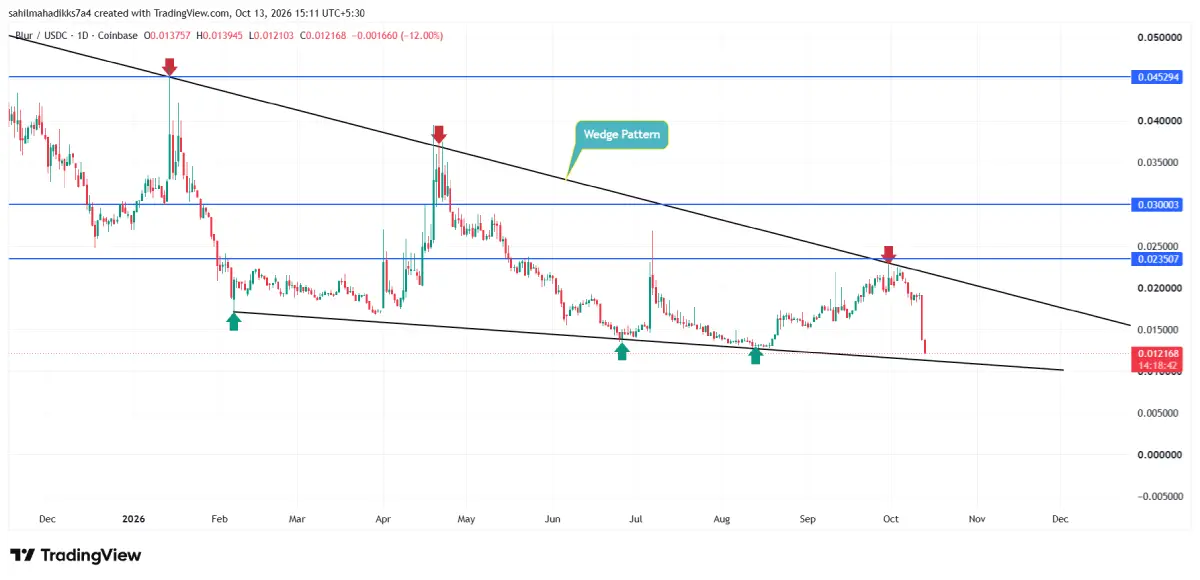
By press time, the BLUR token trades at $0.0123, following an intraday loss of 11.6%. Amid the accelerating selling pressure, the coin price could plunge another 8% and retest a long-coming support trendline at $0.0112.
The daily chart above highlights the support trendline as part of a falling-wedge pattern, carrying the current downtrend since Feb 2026. While the technical support could offer a temporary foothold for BLUR’s price, the protocol’s structural collapse makes a sustainable reversal highly improbable.
Thus, a bearish breakdown below the pattern’s bottom trendline will further accelerate the selling pressure and potentially push BLUR’s price to the $0.001 psychological level.