


Key Highlights:
- TRX price analysis hints a failed breakdown from major support trendline at $0.311 floor.
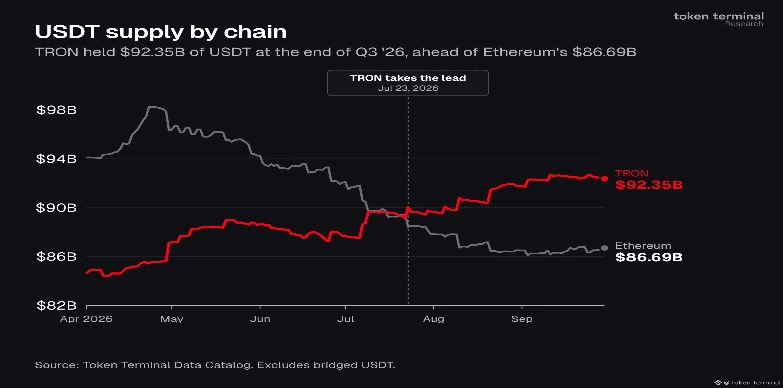
- TRON surpassed Ethereum as the world’s largest network for Tether (USDT), averaging a $90.75 billion native USDT supply and capturing 49.49% of the global market share.
- The ecosystem saw 76.53M unique addresses of stablecoin holders and 17.81M monthly active wallet users.
TRX, the native cryptocurrency of the TRON ecosystem, jumped over 1% on Tuesday, November 3rd, to trade at $0.323. The short uptick displays sustainability amid a 9.5% spike in intraday volume to $556.82 million, and positive market sentiment from the network’s total transactions surpassing 16 billion. In addition, TRON surpassed Ethereum to become the world’s primary network for Tether (USDT), capturing a dominant 49.49% market share.
TRX Price Rebounds Amid Record $90.75B Average USDT Supply
Since last weekend, the TRX price has witnessed heightened volatility following a massive security exploit on Binance, where hackers stole $6.3B worth of digital assets. Amid the broader market panic and attackers moving stolen funds via the TRON ecosystem, the coin price plunged to $0.30 on October 31st.
However, the TRX price has rebounded nearly 6% in the last 72 hours to currently trade at $0.323. This rebound can be attributed to TRON’s fundamental strength and growth, especially in Q3 of 2026, which saw the network expand its position in global on-chain settlements.
According to Token Terminal’s Q3 2026 financial report, the ecosystem reached a notable milestone by officially overtaking Ethereum as the largest network for Tether (USDT), capturing 49.49% of the market share. TRON’s stablecoin supply averaged $92.25 billion for the quarter, supported by a base of 76.53 million unique holder addresses.
This hiked quarterly transaction volume to a record 1.08 billion. Despite this increase in network traffic, average transaction fees dropped over 50% year-over-year to $0.64. This reduction was in response to Proposal 104, a governance update that set energy cost settings on the native network.
The high transaction volume, even with lower fees, drove TRON’s quarterly revenue to $693.21 million, leading all tracked Layer-1 and Layer-2 blockchains with a 93% share of the sector’s total revenue pool.
Most importantly, TRON’s Q3 metrics show that the network is making the transition from more of a retail-focused peer-to-peer application to more structured institutional integrations. Quarterly highlights featured institutional custody, regulated derivatives listings through Bitnomial futures, amongst others, and corporate development.
Furthermore, the launch of the Canary Staked TRX ETF on the Cboe BXZ exchange allowed traditional equity investors to participate in TRX and earn native rewards. With an average of 17.81 million monthly active users, these structural milestones underscore the day-to-day payment routing and real-world asset settlement frameworks that TRON is taking on as it enters the end of the year.
Failed Breakdown Sets TRX Price For Next Rebound Opportunity
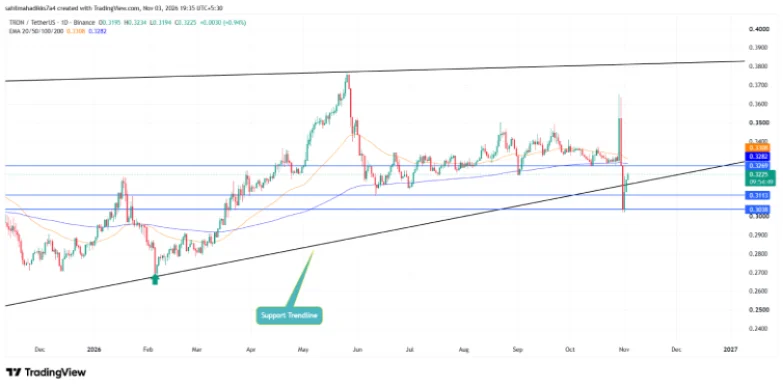
Amid the October 31st sell-off, TRON price gave a decisive breakdown below the long-coming support trendline at $0.315. Since February 2025, the trendline acted as a dynamic support that helped buyers to recoup the exhausted bullish momentum.
However, this sell-off was panic-driven, and the growing network activity bolstered TRX price to rebound, creating a failed breakdown. The previous breakdown must have trapped the hasty sellers in the market, now facing the risk of potential liquidation.
If TRX price continues to show recovery momentum, a bullish breakout from immediate resistance at $0.327 could support a sustained rebound.
The potential move will also reclaim the major exponential moving averages of 100 and 200, accelerating the bullish sentiment in the market.
Conversely, persistent selling pressure across the broader market could trigger a bearish reversal for TRX, increasing the risk of an extended price correction.