




- Global financial markets are transitioning toward tokenization, replacing traditional sequential processing with unified, simultaneous programmable ledgers.
- Tokenized activity remains small compared to legacy markets ($300 trillion), led by short-term repos ($300B–$350B daily) and a $65 billion secondary asset pool.
- Assets are split across isolated liquidity pools and alternative networks, leading to price variations and reduced liquidity.
As asset migration to distributed programmable ledgers becomes more common, the structural framework of global financial markets is undergoing a fundamental redesign. The technological transition is intended to integrate traditionally separate market functions—such as asset issuance, execution, settlement, and servicing—into a single, unified infrastructure.
While traditional mechanisms rely on sequential processing by separate institutions, a programmable network can handle multi-stage processes simultaneously to shorten timelines. However, compared to the vast scale of the legacy global financial system, the current adoption of tokenization remains minimal and isolated.
Scale Disparities and Asset Class Concentration
There is a vast disparity in scale between the digital ledger and traditional capital markets, where the latter accounts for $300 trillion in worldwide assets. Most of the transaction activity enabled by tokenization is concentrated in the short-term collateral segment. Tokenized repurchase agreements, also known as repos, account for the largest share of tokenized activity, generating around $300B to $350B of average daily transaction volume.
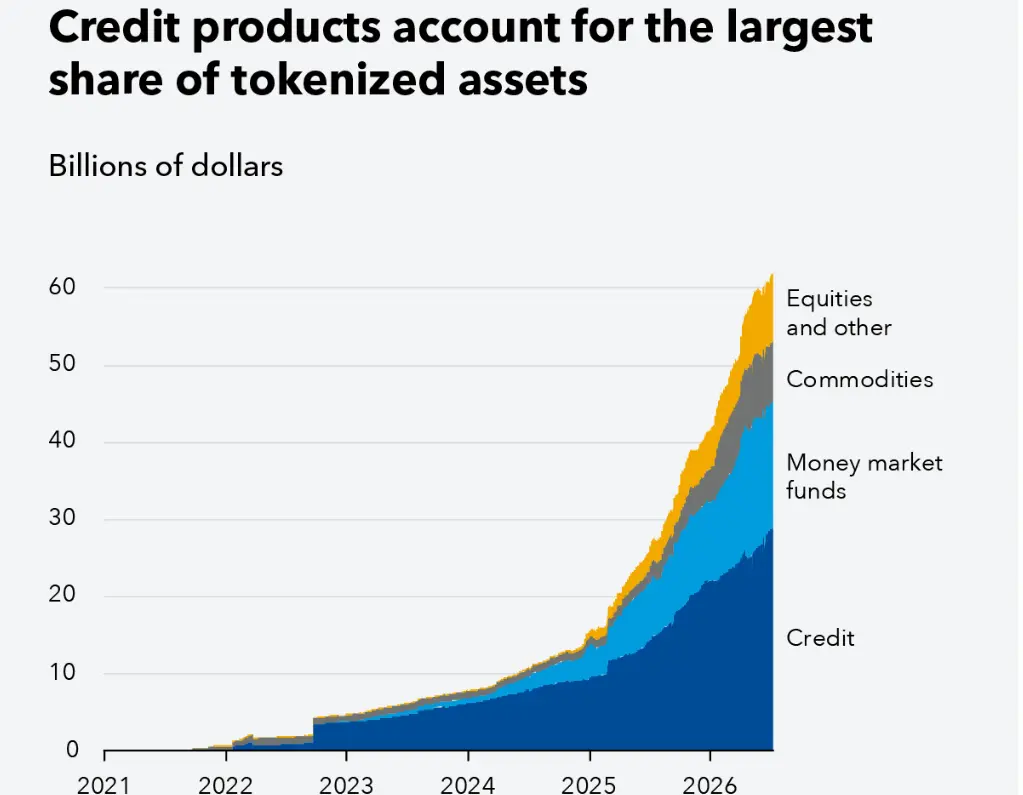
Meanwhile, the other segments of tokenized assets, including credit, money market funds, and equities, among others, add another $65 billion. While these volume numbers are growing rapidly, they are still tiny compared with their traditional versions, as the volume of the US repo market is roughly $13 trillion per day.
Structural Fragmentation Across Platforms
These underlying assets are not evenly distributed, indicating a significantly fragmented infrastructure. In addition to short-term repos, stablecoins, and certain lines of credit on a home’s equity, assets built on tokenization are administered by a variety of platforms instead of a single centralized location, leaving liquidity pools isolated.
This structural disintegration reduces liquidity and causes price differences between platforms. However, there are some operational characteristics that are starting to generate specific user patterns. A key change is the extension of trading hours outside the regular markets. Over 50% of all transactions powered by tokenization take place outside of the typical business day. In normal exchange hours (9:30-16:00), the volume of decentralized exchanges accounts for around 49%, whereas the volume of centralized exchanges accounts for around 44%.
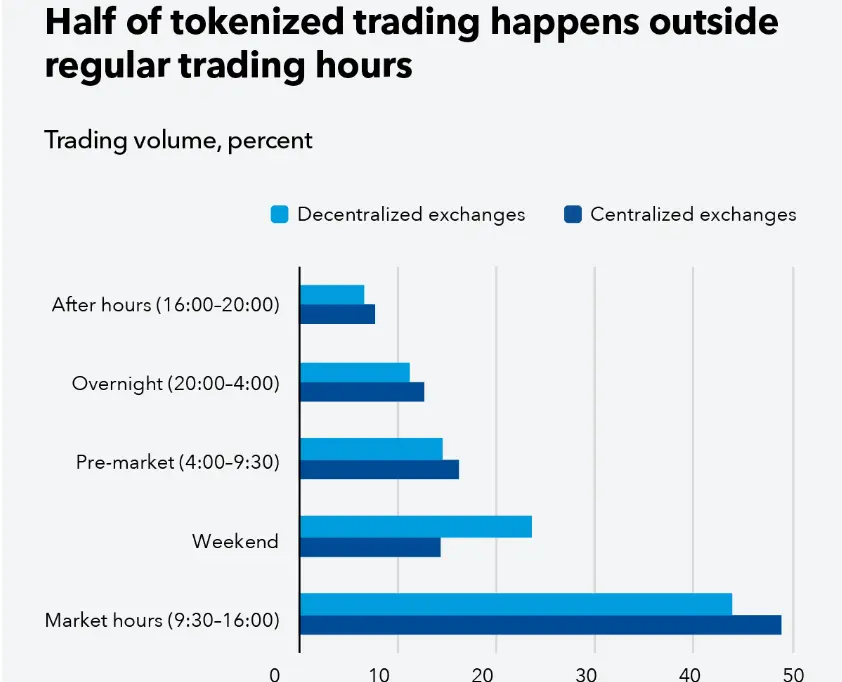
The rest of trading moves entirely into alternative blocks, with decentralized networks handling about 25% of their trading on weekends, and centralized systems handling 16%. The pre-market time (4:00-9:30) represents 18% of decentralized and 16% of centralized traffic; overnight time (20:00-4:00) represents 15% and 13% respectively; and after-hours time (16:00-20:00) represents 10% of decentralized and 7% of centralized traffic.
Retail Participation and Price Discovery Mechanics
At the same time, fractionalisation has reduced capital requirements for retail market participants, especially for equity markets. Some 80% of all stock transactions utilizing tokenization are less than a single share. While these digital exchanges tend to be more volatile and less liquid than public exchanges, the data feeds link back to the public exchanges. The price change within the platform during the night is incorporated into the regular equity market price once the regular market opens, illustrating that both pricing systems respond to the same information signal.
There are four separate operational challenges to greater adoption: legal enforceability, regulatory definitions, network connection, and settlement asset availability. There is no common legal clarity about the relationship between digital tokens and the rights to the underlying assets. Additionally, the regulatory approach to existing compliance rules is still unclear on the translation of these requirements into decentralized ledgers and combined market positions. Isolated liquidity pools need to be technologically interoperable between different networks if they are to succeed. Lastly, the solution to financial settlement on a large scale would be to interlace the secure and universally accepted central money into the ledger systems.
Systemic Risks and Regulatory Frameworks
Controlling these constraints is a double challenge for financial authorities. As networks expand, the elimination of sequential processing removes traditional operational cushions. The transaction costs associated with standard practices such as delayed settlement, sequential messaging, and manual reconciliation also serve to provide protective buffers to institutions facing sudden liquidity pressures.
These periods are eliminated by operating on an instantaneous, fully programmable ledger, which makes systemic shocks transmit quickly. This can increase the likelihood of sudden fire sales, fast liquidity withdrawals, and contagion, or similar effects, due to interconnected leverage.
A technology-neutral regulatory regime is needed to address these structural changes driven by tokenization, ensuring that the same compliance standards apply to equivalent financial actions, whilst clarifying legal rights and supervising the risks of new leverage on digital platforms..