

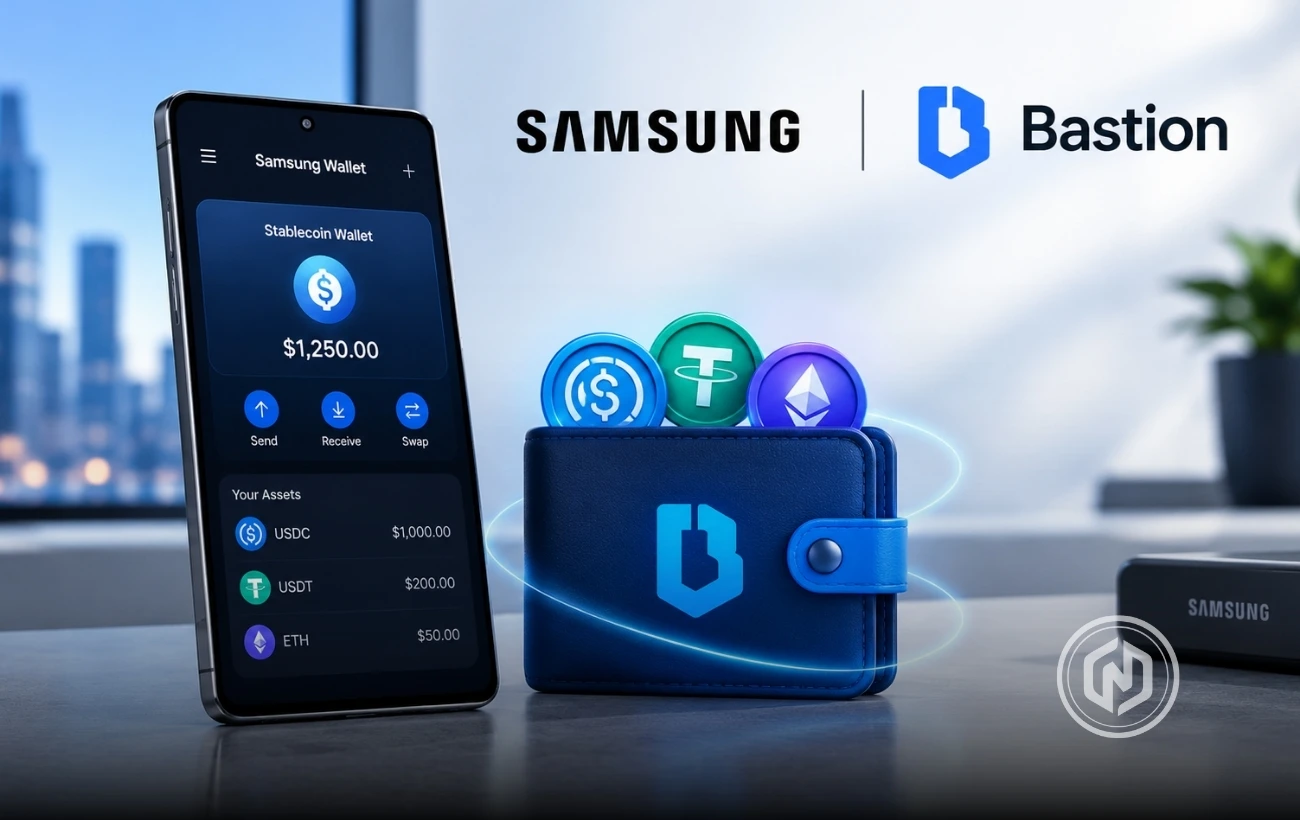


- Samsung has officially named Bastion as a licensed stablecoin custodian and main infrastructure provider to roll out new and compliant digital asset functionalities natively in Samsung Wallet.
- USD Coin (USDC) is launched as the exclusive supported stablecoin, with Solana and Sui providing fast underlying ledger support.
- Galaxy users can store and send digital assets without managing private keys or any external crypto apps via Samsung Wallet.
Samsung Wallet will be adding native stablecoin functionality in the last week of October 2026, introducing the new function to 82 million compatible Galaxy devices in the United States. The tech giant has appointed an institutional enterprise provider, Bastion, as its licensed stablecoin custodian and core infrastructure partner to power this multi-partner ecosystem.
This partnership will allow Galaxy smartphone owners to store, manage, and move digital assets directly from their built-in digital wallet. The integrated system eliminates the hassle of downloading third-party cryptocurrency apps or protecting highly complex private keys. At launch, USD Coin (USDC) will serve as the exclusive debut stablecoin supported by the wallet platform. Furthermore, Bastion is collaborating with Coinbase, utilizing its specialized Coinbase Prime Vault service to act as the official USDC sub-custodian.
Strategic Blockchain Integration: The Solana and Sui Layer
Solana and Sui are providing the base infrastructure for the main ledger, with high-speed processing and stability being key factors. The multi-partner service leverages these specific layer 1 networks as opposed to legacy chains, thereby enjoying high transaction volumes and low latency. This enables the wallet to handle a large number of consumer transactions and worldwide data exchanges in real time. This network architecture ensures that user transfers are completed efficiently on decentralized infrastructure that can scale to millions of daily active mobile devices.
“The crypto industry has spent years talking about reaching the mainstream, and this is what it looks like. Samsung is putting stablecoins in front of millions of U.S. Galaxy users,” said Nassim Eddequiouaq, CEO of Bastion.
Bastion’s Backend Infrastructure and Global Remittances
Bastion’s API framework works behind the scenes to handle vital backend tasks, account management processes, and legal compliance procedures. The provider keeps individual users’ ledgers, manages asset custody, and handles USDC transfers across the supported networks. Security and fraud mitigation are central to the architecture.
Bastion performs user verification, checks destination blockchain addresses, and performs active transaction monitoring to detect money laundering, fraud, or sanctions violations. The platform ensures transactions are secured with device-specific digital signatures and demands biometric authentication from the user before any transaction can be made.
Stablecoins have the potential to make moving money around the world faster and easier, and we want Galaxy users to be able to take advantage of that without having to navigate the complexity of traditional crypto tools, said Woncheol Chai, EVP and Head of the Digital Wallet Team at the Mobile eXperience (MX) Business at Samsung Electronics.
In addition to local storage and peer-to-peer transfers, this built-in utility allows global remittances. Galaxy users can transfer money directly from their wallet to bank accounts in more than 60 countries. Bastion does this by converting the digital currency and transferring the funds in local fiat currencies through its worldwide network of regulated financial partners. The joint venture aims to eventually add physical retail use to its services, where users could buy online or tap their device at a point-of-sale terminal, before expanding into international markets.
The deployment follows key corporate structure regulatory milestones for Bastion. Its operating unit, Bastion Platforms US, LLC, is registered as a Money Services Business with FinCEN and maintains a portfolio of state-level money transmitter licenses. The company’s recent acquisition of a conditional national approval from the Office of the Comptroller of the Currency (OCC) to use a national trust bank charter also raised its regulatory profile in the banking industry.