


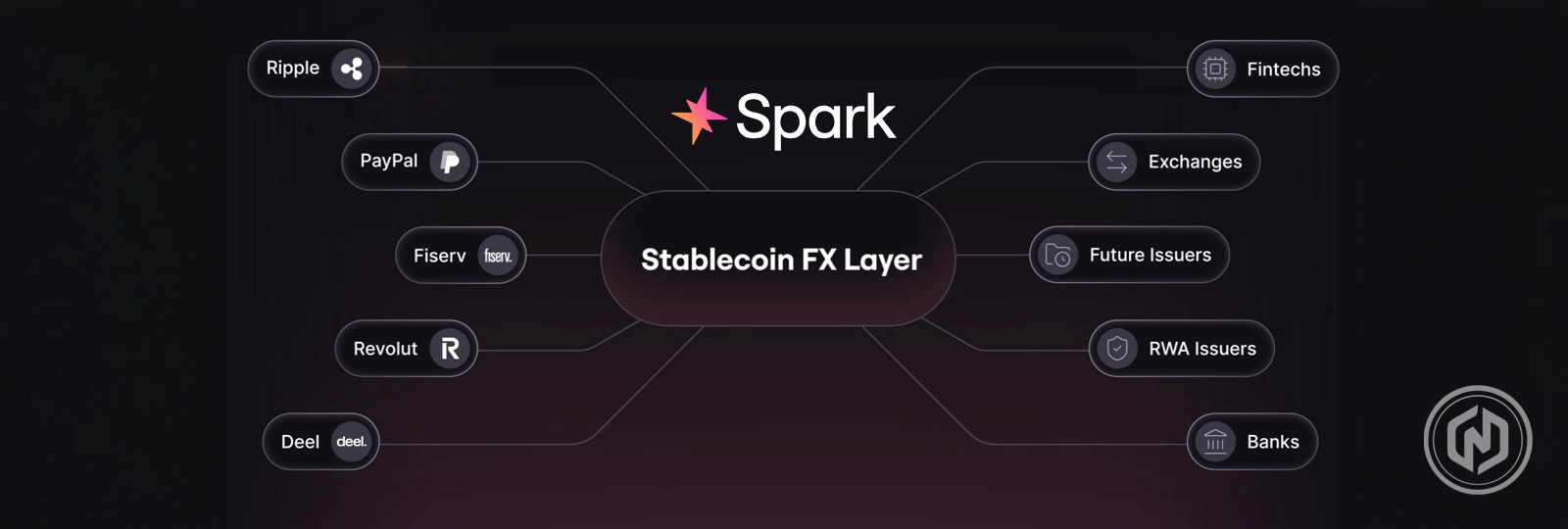


- On Thursday, Spark announced the launch of the Stablecoin FX layer, which is built on Uniswap v4.
- The shared liquidity platform is expected to resolve the issue of fragmented liquidity across various isolated pools and issuers in the rapidly growing stablecoin market.
- Amid the growing regulatory clarity, many financial institutions and payment companies are integrating stablecoins by various means, which creates fragmentation of liquidity.
On June 25, Spark, a leading decentralized finance platform, revealed the launch of the Stablecoin FX Layer, which is developed on Uniswap v4.
The layer will create a shared liquidity infrastructure designed to resolve a major issue of fragmented liquidity around the growing stablecoin market.
According to the official announcement, the initial deployment will migrate approximately $150 million in liquidity to Uniswap v4 with a pool support of the first USDS/PYUSD and USDS/USDT pools. It will create a “liquidity foundation” for swap pools supporting USDS, Tether’s USDT, and PayPal’s PYUSD.
Spark will work the orchestration layer for managing liquidity allocation and governance, while Uniswap will provide the programmable automated market maker architecture.
Spark Aims to Resolve Issues of Fragmented Liquidity in Stablecoin Market
The FX Layer is working as a shared liquidity and exchange infrastructure on Uniswap v4. The layer will open doors for multiple stablecoin issuers like banks, fintechs, and payment companies to plug into a common system instead of each bootstrapping their own liquidity pools, market makers, and inventory management. Spark will help this ecosystem to decide how liquidity is allocated, governed, and coordinated across various stablecoins.
The announcement comes at a time when many financial institutions and payment companies are preparing to launch their own stablecoins amid growing regulatory clarity.
Spark CEO Sam MacPherson stated in the official post on X, “We will see stablecoin adoption increase by an order of magnitude as payments come on-chain. This new adoption will be fragmented across the various EAs, straining the current market-making environment.”
“Built on Uniswap v4, Spark is uniquely positioned to bootstrap the on-chain FX layer for EAs to swap excess inventory into their own stablecoin. Access to the liquidity of the largest on-chain stablecoin, USDS, provides a fundamental advantage that enables the economics to work at scale,” he said.
Stablecoin Market Witnesses Institutional Rush with Regulatory Developments
The launch of Stablecoin FX Layer is coming at a time when the stablecoin market has been witnessing explosive growth in the last few months, thanks to growing regulatory clarity. After U.S. President Donald Trump signed the GENIUS Act into law, the stablecoin issuers have received a clear guideline. The federal law requires stablecoin issuers to maintain 100% backing by USD liquid assets like cash and Treasuries.
According to DeFiLIama, the cumulative market capitalization of the stablecoin market is revolving around $314 billion, with the dominance of USDT. The monthly transaction volume has soared above $1 trillion. The reason behind its growing adoption is the benefits, such as attractive stablecoin yields.
In the last few months, many financial institutions and payment companies have integrated stablecoin into their existing financial infrastructure. For example, Visa has expanded its support for USDC settlement. In December 2025, Visa announced the launch of U.S. stablecoin settlement for issuers and acquirers by using Circle’s USDC on blockchains like Solana.
Apart from this, Mastercard also announced the acquisition of BVNK, which is a leading stablecoin infrastructure provider, in March. Mastercard’s subsidiary, Mastercard Transaction Services, has also secured a BitLicense from the New York State Department of Financial Services (NYDFS).
Despite the growing adoption of stablecoins, the banking sector is raising objections to stablecoin provisions for yields mentioned in the CLARITY Act. The major concern of the banking sector is that stablecoin yield might take deposits away from the traditional banking sector.
JPMorgan Chase CEO Jamie Dimon raised concerns over stablecoin in May, saying that, “it allows them to effectively pay interest on deposits, stablecoins or something like that, without the protection that they should have. The banks will not accept it that way. … I’m not worried about stablecoins, but if it happened, I’m telling you I will have nothing to do with it and it will eventually blow up.”