





- CME and ICE pressure U.S. regulators to tighten oversight on Hyperliquid’s Trading Platform citing concerns over market manipulation
- The intense overhead supply at $47.5 resistance could push Hyperliquid price back to $40 support region.
- The HYPE price positioned above the key daily exponential moving averages (20, 50, 100, and 200) indicate the broader market sentiment is bullish.
On Friday, May 15th, the Hyperliquid price shows a major rejection from the $45.7 resistance, with a long-tail rejection daily candle. The initial reversal followed Bitcoin’s pullback below the $80,000, but the selling pressure on HYPE accelerated as Traditional finance giants CME and ICE are pushing U.S. regulators to tighten their scrutiny of Hyperliquid, citing concern over oil price fluctuation and market manipulation. The potential regulatory risk could pressure growth potential for the HYPE price and drive a prolonged consolidation trend.
Hyperliquid Faces Regulatory Heat as CME and ICE Push U.S. Crackdown
Traditional finance giants—including the Chicago Mercantile Exchange (CME) and Intercontinental Exchange (ICE)—have launched a coordinated lobbying effort urging U.S. authorities to crack down on Hyperliquid. The rising conflict is a significant flash point between traditional banking and the growing world of decentralized finance (DeFi). At the heart of the dispute is a battle over global price discovery, regulatory compliance, and market dominance.
The main driver of this Wall Street backlash is Hyperliquid’s 24/7 trading platform. Traditional derivatives exchanges are closed over the weekends and have strict operating hours. Hyperliquid, on the other hand, offers perpetual contracts for West Texas Intermediate (WTI) crude oil, which can be traded on the clock.
Macro traders come to Hyperliquid on weekends when geopolitical shocks hit the market to price in risk. Legacy institutions insist that an unregulated, retail-market-driven platform that sets the minimum price for commodities around the world before markets open is a recipe for market instability and for dangerous distortions.
In addition to price discovery, traditional exchanges say that Hyperliquid causes huge compliance gaps. Regulated entities invest a lot in Know-Your-Customer (KYC) and Anti-Money Laundering (AML) protocols, while Hyperliquid enables permissionless trading through decentralized wallets. Wall Street has told regulators that this approach allows for market manipulation, front-running, and sanctions violations by bad actors in the global commodities system.
In addition, the native liquidity pool of Hyperliquid, the HLP vault, is targeted by legacy institutions. Traditional clearinghouses are market matchmakers; the HLP vault is an automated market matchmaker and direct counterparty to liquidations.
The setup, some critics say, reflects an aggressive, unregulated offshore exchange as opposed to a neutral public utility, and provides Hyperliquid an unfair, asymmetric advantage.
Hyperliquid is playing a more aggressive defensive game in response to the increased pressure from the regulators. The protocol created the Hyperliquid Policy Center that lobbies Washington and works closely with the Commodity Futures Trading Commission (CFTC) to find a space that is compliant with decentralized perpetual swaps.
It’s no longer just a legal matter; it’s a financial paradigm shift. In the battle between Hyperliquid and traditional players, the result could shape the future of how decentralized technology is incorporated into global macro markets.
Hyperliquid Price Faces a 10% Downside Risk Within Channel Pattern
Over the past month, the HYPE price has traded in a narrow sideways trendline, extending from $45.7 to $38.7. Amid the geopolitical and macroeconomic developments in the global market, the coin price reverted at least twice from either boundary of the range, indicating a lack of initiation from buyers to sellers to drive a directional rally.
Even today, the HYPE price failed to break out from the overhead $45.7 resistance, creating a long-wick rejection in the daily candle. If the overhead supply remains intact, the coin price could revert roughly 10% to a retest of the long-awaited support trendline of the channel pattern at $39.8.
Since January 2026, the rising channel pattern has carried a stable recovery force in HYPE price, maintaining the classic formation of higher-highs and higher lows. Until the pattern is intact, the coin price will maintain its mid-term uptrend.
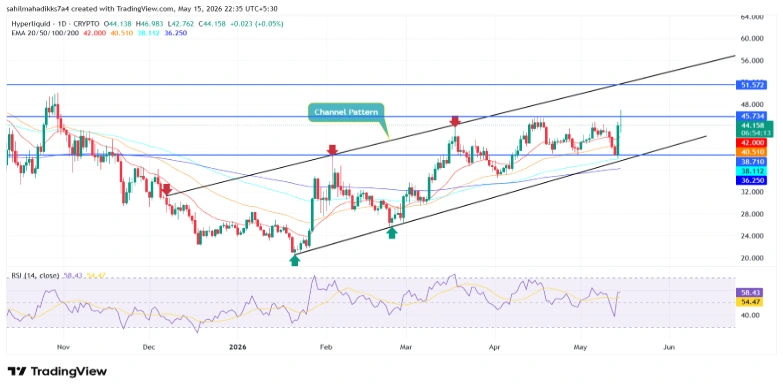
On the contrary, if the regulatory-risk-driven selling pressure fails to drive a bearish pullback, the coin price could attempt a breakout from the $45.7 resistance to accelerate its market buying pressure.