


- Sen. Tillis says the CLARITY Act is ready to move toward a Senate committee markup very soon.
- Stablecoin yield concerns ease as lawmakers prepare new compromise text before Senate markup.
- Stablecoin market growth raises pressure for clearer U.S. crypto rules and federal oversight.
Sen. Thom Tillis said he is ready to push the CLARITY Act toward committee markup, signaling fresh movement for the stalled Senate crypto bill. His comments came after the Senate Banking Committee advanced Kevin Warsh’s Federal Reserve chair nomination.
Basically, the CLARITY Act remains one of Washington’s key digital asset bills after the House passed H.R. 3633 in July 2025. The measure cleared the chamber by a bipartisan 294-134 vote and seeks clearer rules for crypto markets.
CLARITY Act Moves Toward Markup
According to an X post by Eleanor Terrett, Tillis said he would ask the committee chair to schedule a markup when lawmakers return. He added that the CLARITY Act had made “a lot of progress” and should move before the committee.
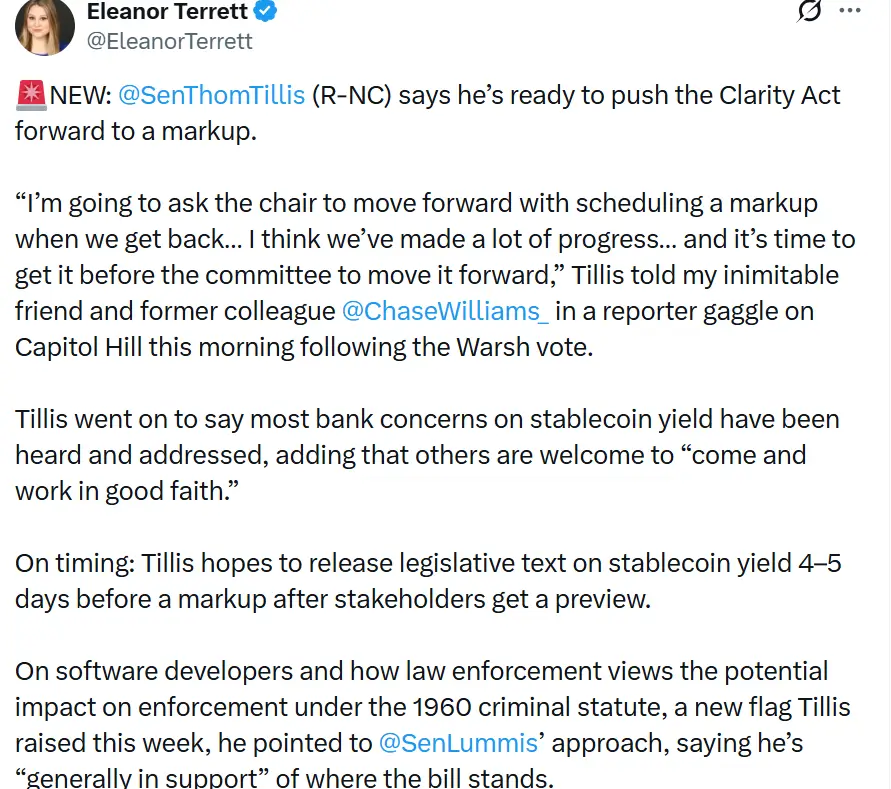
Sen. Tillis Pushes for CLARITY Act Markup (Source: X Post)
Initially, the bill would expand the Commodity Futures Trading Commission’s role over spot digital asset markets. It would also set standards for customer fund protection, platform registration, and market transparency.
However, the Senate path for the CLARITY Act has been slower as lawmakers remain divided over stablecoin yield. Against that backdrop, Tillis said most bank concerns around yield had been heard and addressed.
He also addressed software developer concerns tied to law enforcement interpretation under the 1960 criminal statute, a law that covers unlicensed money-transmitting businesses. On that issue, Tillis pointed to Sen. Cynthia Lummis’ approach, saying he is generally supportive of where the bill stands.
Stablecoin Yield Dispute Narrows
The main dispute around the CLARITY Act centers on whether stablecoin issuers can offer yield, rewards, or incentives. Banks have pushed for language restricting yield-bearing dollar tokens.
Banks argue that stablecoin yield could pull deposits away from regulated lenders and reduce credit availability. Crypto firms, on the other hand, argue that a broad ban would weaken competition and payment innovation.
However, a White House Council of Economic Advisers analysis on April 8 challenged the scale of those concerns. It found that a stablecoin yield ban would increase bank lending by only $2.1 billion, or 0.02%. The same analysis estimated that such a prohibition would create an $800 million welfare cost.
Consequently, that data has become central to the CLARITY Act yield debate. Meanwhile, Sen. Tillis said the revised stablecoin yield text could be released four to five days before markup. Galaxy Research identified that text, a markup announcement, and the vote margin as key milestones.
Market Data Raises Stakes
The CLARITY Act debate is unfolding as stablecoins gain wider financial use. DeFiLlama data shows the stablecoin market cap near $320.7 billion, with USDT at 59.1% dominance.
Visa also said its stablecoin settlement pilot reached a $7 billion annualized run rate. The pilot now covers nine blockchains, including Base, Polygon, Arc, Canton, and Tempo.
For lawmakers, the CLARITY Act now sits between bank deposit concerns and crypto payment growth. Tillis’ remarks, nonetheless, show the Senate may be moving closer to a formal debate.
Also Read: LayerZero Team Wallet Deposits $1.43M in ZRO to Binance