

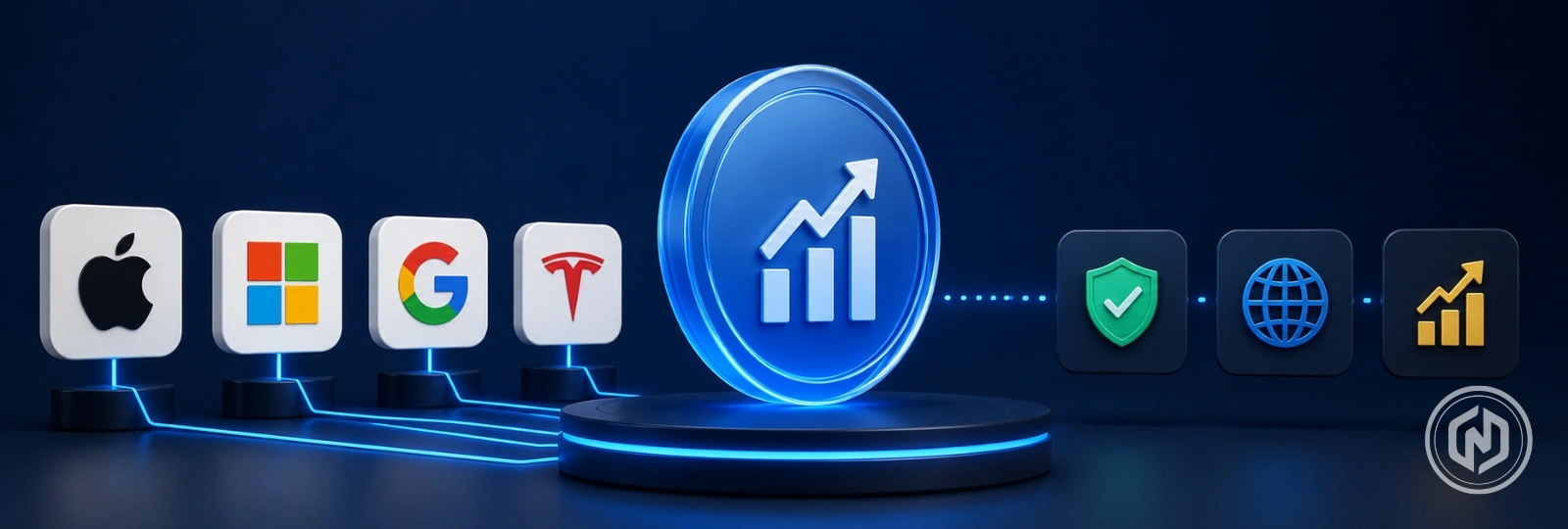


Tokenized real-world assets are now worth around $18 billion. According to research from Coinbase, that is an 18 times increase since 2022. Tokenized equities, which are also called tokenized stocks or tokenized shares, are digital tokens on a blockchain that represent either ownership of real company shares or exposure to their price changes.
According to a Citigroup report, the tokenized asset market is expected to grow by $5.5 trillion in the base case for tokenized assets by 2030.
The actual shares are kept safe by a regulated custodian. This article explains everything you need to know, including how tokenized stocks work step by step, the three main types available today, their benefits, and risks.
What Are Tokenized Equities?
Tokenized equities are digital versions of traditional stocks that live on a blockchain. They are not a new type of company share. Instead, they are a modern way to represent existing shares. For every token issued on the blockchain, one real share or a fraction of a share is held safely by a regulated custodian outside the blockchain. Smart contracts handle important tasks automatically, such as creating new tokens, paying out dividends, checking compliance rules, processing transfers, and, in some cases, managing voting rights.
Most tokenized equities in 2026 run on networks that work with the Ethereum virtual machine, such as Ethereum, Base, or Polygon. These networks are providing enhanced security with low-cost transactions. Also, it has the ability to integrate with different systems.
There is a major difference between tokenized equities and native crypto tokens, which is the origin of their value. Tokenized equities are generating their value directly from the performance of the real-world stock behind them, such as Apple or Tesla shares. They do not get value from blockchain speculation or from how useful the network is.
According to rwa.xyz, the total distributed value of tokenized stocks is revolving around $1.55 billion.
How Tokenized Stocks Work — Step by Step
Tokenized stocks are connecting traditional ownership of company shares with blockchain technology. A regulated company holds the actual shares in custody, while smart contracts manage the digital tokens on the blockchain. This kind of setup is increasing the speed of trading, the ability to own fractions of shares, and programmable features, all while keeping a direct connection to how the real-world company performs.
Here is the step-by-step process of how it works:
Step 1 – Custody
A regulated issuer or financial institution buys real shares of a company, such as Apple or Tesla, through a licensed broker. These shares are then kept safely with a qualified custodian, which could be a bank or another licensed entity, outside the blockchain. This process guarantees that every token is backed one-to-one by a real share and that all rules and regulations are followed.
Step 2 – Minting
The issuer uses a smart contract to create digital tokens on a blockchain, often Ethereum, Base, Polygon, or Solana. Each token stands for one full share or a fraction of a share. The process of creating tokens is usually linked to proof of reserve systems, which allow them to ensure transparency.
Step 3 – Trading
Investors can buy and sell these tokenized equities on platforms that support them, on centralized exchanges with certain restrictions, or on compatible decentralized finance protocols. The prices of the tokens follow the real-time value of the original stock.
This is done through decentralized oracle networks such as Chainlink, which bring accurate market data onto the blockchain. Unlike traditional stock markets that have set trading hours, trading of tokenized stocks can happen almost at any time of day.
Step 4 – Corporate Actions
Smart contracts handle important tasks in an automatic manner, such as paying out dividends, which are often sent in stablecoins, managing stock splits, and, in some setups, allowing token holders to vote by proxy. This cuts down the manual work and mistakes, while also making the whole process more efficient.
Step 5 – Redemption
Token holders can usually exchange their tokens for cash, or in some cases, for the actual shares themselves. The issuer or the custodian manages this redemption process. When tokenized equities are redeemed, the corresponding digital tokens are destroyed, or burned, to maintain the 1:1 backing.
Infrastructure for Tokenized Equities
There are many parts behind the ecosystem of tokenized equities. Decentralized oracles, such as Chainlink, provide live price updates and proof of reserve verification. This ensures that the tokenized equities on the blockchain accurately reflect the value of real-world assets and the reserves held off-chain.
The transaction of tokenized equities almost takes place on the same day. This is called the T+0 settlement. Traditional stock trades will take one or two days to settle.
Faster settlement reduces the risk that the other party will not pay and frees up money more quickly. This is one of the biggest advantages of tokenized stocks.
Fractional ownership is another benefit. Smart contracts can split a token into many small pieces, allowing investors to buy small amounts of a high-priced stock without needing to purchase a full share.
An important note is that most tokenized equities are available to everyday retail investors to provide economic exposure rather than full legal shareholder rights, such as voting in every case. Full ownership models do exist, but they are more common in institutional products or in systems where shares are issued natively on the blockchain.
This structure connects traditional finance with blockchain technology. It delivers real improvements in speed and efficiency while still relying on regulated custodians to keep the assets safe. Like any investment, tokenized stocks carry risks, including risks related to the other party involved, changing regulations, and potential bugs in smart contracts. Investors should do their own research and talk to their advisors before investing.
Tokenized vs. Traditional Stocks: Core Differences
| Feature | Traditional Stocks | Tokenized Stocks / Equities |
| Trading hours | Exchange hours only (Mon–Fri) | 24/7, 365 days |
| Settlement | T+1 or T+2 business days | Near-instant (T+0) on-chain |
| Minimum purchase | 1 full share (or broker fractional) | Any fraction via smart contract |
| Intermediaries | Broker, clearinghouse, CSD | Smart contracts replace most |
| Geographic access | Requires local broker/account | Global — wallet + internet |
| DeFi composability | None | Collateral, lending, yield farming |
| Dividends | Paid by the broker periodically | Auto-distributed via smart contract |
| Regulatory clarity | Fully established (FINRA, SEC) | Evolving — varies by jurisdiction |
Who Offers Tokenized Stocks? Platform Landscape
The market and tokenized equities have grown a lot in 2026. There are many companies and trading platforms that are leading the way in integrating these new products.
Due to current rules and restrictions in the United States, most of these products are offered to investors living outside the country. In most cases, investors get what is called economic exposure, which means that they can track the price of a stock and receive dividend payments. However, they usually do not receive full legal rights as shareholders, such as the right to vote on company matters.
1. Centralized Exchanges
Amid growing regulatory clarity and demand for RWAs, major cryptocurrency exchanges are planning to re-enter the tokenized equities market with a better compliant structure.
For example, Binance closed its earlier tokenized stock product in 2021, and in 20206, it has returned. It is now offering Ondo Finance’s tokenized U.S. stocks and ETFs and has previewed its own bStocks tokenized securities, providing access to thousands of U.S. equities for eligible users.
Coinbase is planning to explore tokenized stock products as part of its expansion into traditional assets.
Kraken has recently launched xStocks, which is powered by Backed Finance. It is currently offering around 100 tokenized U.S. stocks and ETFs.
2. Fintech and RWA Platforms
These companies, such as RWA Inc, are the main providers of tokenized stocks that are available to everyday retail investors and within decentralized finance platforms.
Ondo Finance, through its Ondo Global Markets division, is the clear leader in this space as of 2026. It has more than $1 billion in total value locked, and it is providing more than 200 to 260 tokenized United States stocks and exchange-traded funds.
Each token is fully backed 1:1 by real shares held by American broker-dealers. The tokens are available on Ethereum, Solana, and the BNB Chain. Investors can trade them at any time of day, receive dividends, and use them in DeFi applications. However, these products are mainly for investors outside the United States who meet certain eligibility requirements.
3. DeFi-Native and Perpetual Protocols
Decentralized finance is native and perpetual protocols include Ostium and similar platforms. This is focusing on providing services for on-chain perpetual futures and synthetic exposure to stocks, stock market indexes such as the S&P 500, and commodities. They provide leveraged price tracking instead of direct 1:1 asset backing. They use Oracle networks to get pricing data.
4. Institutional and Bank Platforms
Institutional and bank platforms are also emerging. J.P. Morgan Kinexys is also operating on permissioned blockchains that are only open to approved institutional clients. It focuses on tokenizing funds, collateral, deposits, and settlements. It does not retail tokenized stocks.
Other trading players, such as the Nasdaq and New York Stock Exchange, are also running pilot programs to test tokenized settlement systems.
Risks and Challenges of Tokenized Stocks
| Risk | What it means for investors |
| Custodian risk | If the regulated custodian holding the real shares fails, token holders may lose their claim, similar to brokerage insolvency risk |
| Regulatory fragmentation | Rules differ sharply by jurisdiction; a token legal in Germany may be illegal for US investors; cross-border trading remains complex even in 2026 |
| Smart contract risk | Bugs in smart contract code can freeze funds or enable exploits; synthetic structures with oracle dependence are especially vulnerable |
| Limited shareholder rights | Most tokenized stock structures give contractual claims, NOT full voting rights or direct legal shareholder protections |
| Liquidity risk | Tokenized stock markets are thin compared to traditional exchanges; large orders can move prices significantly |
| Tax complexity | IRS treats crypto as property; each token transfer may be a taxable event; dividends received on-chain require reporting — consult a tax professional |
Future of Tokenized Stocks: 2026 and Beyond
Tokenized real-world assets (RWAs) are still mostly made up of tokenized United States Treasuries and money market funds. These two categories account for the largest share of the roughly $30 billion or more in total on-chain RWA value as of the middle of 2026. In March, the U.S. Securities and Exchange Commission (SEC) approved a filing to allow Nasdaq to trade and settle certain tokenized securities. Tokenized stocks, although a smaller part of the market with an estimated value of around $1 to $1.5 billion earlier in the year, are seen as the next big area for growth.