




Even though there had been a bullish surge in May and it kind of hinted at Bitcoin getting its footing again, the wider crypto is under fresh pressure once June showed up. Right at the start, things felt shaky, and by June 4 Bitcoin slipped under $64,000, this move came after a wave of liquidations swept through the market alongside increasing political tensions.
The cryptocurrency is currently trading at around $63,474 with a drop of 22% in the last 1 month, according to CoinMarketCap. This is the lowest since April and around 45% down from its all-time high (ATH) recorded at around $126,000 on October 6, 2025.
The volatility in BTC price has sparked fear into the entire crypto sector, which is also visible in the search trend. For example, the search for “Bitcoin bear market” has reached a 5-year high as the Fear and Greed index has dropped below 20 and indicates extreme fear within the crypto market.
6 Reasons Behind the Crash of Bitcoin (BTC)
The current crash did not happen due to a single factor. There are several macroeconomic factors along with growing geopolitical tension that have affected the crypto market today. These reasons have been listed below:
1. Bitcoin ETF Sees 13-Day Outflow Streak
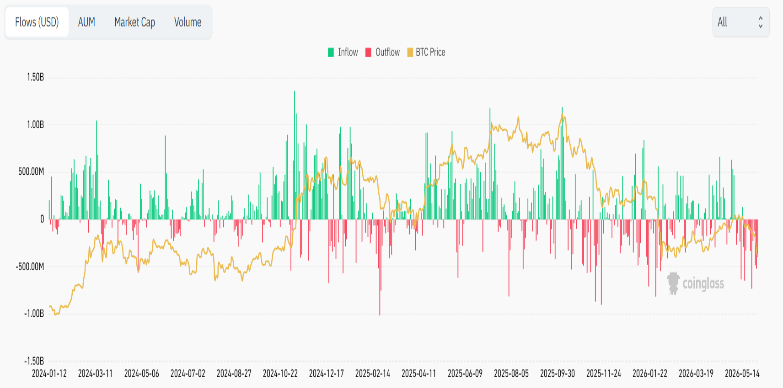
U.S-based spot Bitcoin ETFs are witnessing a very difficult time of its history. It is facing one of the heaviest selling periods after its launch in January 2024. As of June 4, these funds have witnessed a concerning outflow streak of 13 trading days. According to ETF trackers, the total outflows amount taken out is approximately $4.4 billion.
(Source: Coinglass)
On June 1, the ETFs witnessed an outflow of around $483 million. On June 2, the outflow in BTC spot ETFs soared to $519 million, while on the following day, it recorded an outflow of more than $396 million.
This is the biggest outflow streak witnessed in the spot BTC ETF’s history. It has also broken the previous streaks, which lasted for 8- and 9-days. According to Coinglass, the outflow in BTC ETFs started around May 15. At the time of writing this, the daily net inflow is showing a negative $396.60 million. This clearly suggests that institutional investors are withdrawing their money from the crypto market.
Among all BTC ETFs, BlackRock iShares Bitcoin Trust (IBIT) has recorded the biggest outflows during the recent streak. For example, on May 27, IBIT recorded an outflow of around $527.80 million. It is responsible for a large amount of the total withdrawal in the last 13 days, which is around $3.3 billion. This is around 75% of all money taken out from the BTC ETFs in 13 days.
The intense withdrawals of money from BTC ETFs are coming at a time when the BTC price has dropped. On June 4, Bitcoin plunged from $68,000 to $64,000, which is the lowest since February. This marks a decline of around 14% over the past week and more than 20% from its May peak of nearly $85,000.
2. Strategy’s Symbolic BTC Sale
The biggest Bitcoin holding public company on the earth, Strategy, has recently revealed that it has sold 32 BTC, which is worth around $2.5 million at the current price. While in comparison to its BTC holding of 843,706, this was not a major dump, though it has sparked a discussion about the company led by Michael Saylor’s intention, who always advises to “HODL” BTC during bear cycles.
This is the first Bitcoin sale that happened after December 2022. This transaction was revealed in the latest SEC Form 8-K filing on June 1.
According to the filing, the sale took place between May 26 and May 31 at an average price of around $77,135 for each BTC. The money generated from this sale was used to support dividend payments on its STRC perpetual preferred stock.
Although this was only 0.0038% of Strategy’s total holding, this news has damaged confidence in the crypto market, as this is the major change from their stance of “never sell.”
Peter Schiff, the biggest BTC critic, poked Strategy after this, said that, “Since Bitcoin’s biggest buyer has now become a seller, where will the new demand come from to sustain the pyramid?”
3. Mt. Gox Distribution Sparks Fears
On June 2, the defunct cryptocurrency exchange, Mt. Gox made a transfer of 10,422.65 BTC to new wallets. The cumulative worth of these BTC was around $739 million at the time of selling.
According to on-chain data shared by Arkham Intelligence, these transactions happened in two different tranches, where the first transaction of 10,306.35 BTC was moved to a new wallet. In the second transaction, around 116.30 BTC were transferred to a known Mt. Gox hot wallet.
Mt. Gox is still holding around 34,504 BTC, which is around $2.43 billion at the time of writing.
Mt. Gox suffered a hack back in 2011, and in 2014, the cryptocurrency exchange filed for bankruptcy. It has been more than 10 years since Mt. Gox creditors have been waiting for their money to get back. These creditors can generate large profits if they get their payouts. The deadline for repaying creditors is October 31, 2026. This is the final deadline, after it was extended many times in the past.
Every time large amounts of Bitcoin move from crypto wallets linked to Mt. Gox, the crypto community thinks that they could be moved to exchanges, custody services, or directly in order to dump them and book a profit.
4. Geopolitical Tension Amid U.S.-Iran War
The situation between the U.S. and Iran is currently looking tense after the peace deal failed in Islamabad, Pakistan. In the fresh escalation, Iran has attacked U.S. military bases and airports in Kuwait. While the crypto market was recovering after the ceasefire, the latest exchange of missiles between the U.S. and Iran has boosted selling pressure in the crypto market. This has created an intense selloff in BTC price.
Apart from this, the inflation rate is rapidly increasing. In April, U.S. consumer prices soared more than expected after the annual inflation rate soared to 3.8%. This was due to the global energy crisis created after the blockade of the Strait of Hormuz, which is a major supply route for the global economy. It is responsible for more than 20% of the world’s oil.
Due to this war, Bitcoin miners are also suffering as their stocks decline, as the BTC price crashes around or below production costs.
5. Macro Economic Factors
The United States Consumer Price Index (CPI) soared to 3.8% in April 2026 in comparison to the same month in 2025. This is the highest inflation rate since May 2023. This is more than expected by experts due to the rise in energy prices after the U.S.-Iran war.
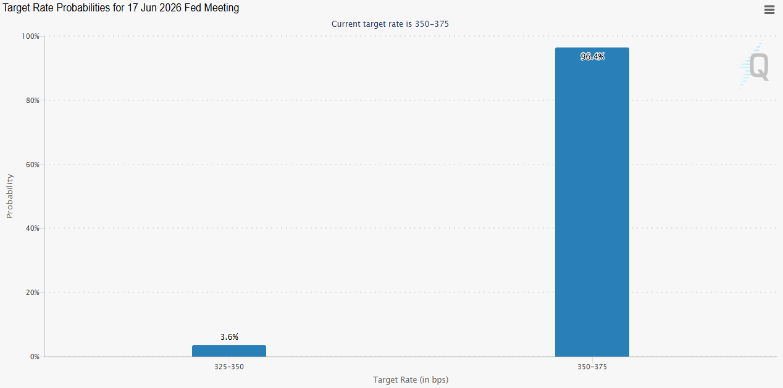
The growing inflation rate has also increased yields on United States Treasury bonds. The yield on the 10-year Treasury notes has soared around 4.5%. At the same time, the 30-year yield has crossed the level that was never witnessed in the last few years after it soared by 5%. Due to this, there are also fewer chances of Fed rate cuts in the upcoming FOMC meeting in June, according to CME Group.
6. 4-Year Cycle and Capital Rotation into AI Stocks
During the previous bull run in 2025, many experts were saying that the 4-year cycle of Bitcoin had ended. This cycle is a price pattern linked to BTC halving events.
However, Lark Davis, a crypto market analyst, has recently affirmed that the crypto market is currently in the “bear leg” of a 4-year cycle in 2026. After creating a new all-time high at $126,000 in late 2025, Bitcoin has entered into a new correction phase.
In his analysis, Lark Davis also mentioned that investors are likely to withdraw their money from Bitcoin and other cryptocurrencies in order to invest in artificial intelligence (AI) stocks. These stocks have gained the attention of investors amid the boom in the AI sector.
He mentioned that there is a growing divergence between Bitcoin and other tech stocks. This is also raising questions on a claim that Bitcoin is working as a “high-beta” version of the Nasdaq.
What Analysts Actually Say About Recovery
Despite the current turmoil in the crypto market after major liquidation, many popular analysts are still very optimistic about Bitcoin predictions. The majority of them have set their price target between $120,000 and $175,000. Even some forecasts are suggesting that BTC could soar above $200,000 in the long-term.
Financial Institutions such as Bernstein, Standard Chartered, JPMorgan, and Citigroup have shared their target between $150,000 and $170,000 by citing a growing adoption among institutional investors and steady inflows in BTC ETFs during the recovery time. Also, many investors are treating it as digital gold and planning to HODL it for a longer period of time.
On the other hand, there is also some bearish outlook that says that BTC might see further downfall in the third quarter of 2026 and fall below $40,000.
Is Crypto Dead? The Honest Answer
Every time BTC and the overall crypto market enter a bear cycle, there is one question that always starts making rounds in the market: Is crypto dead?
The answer is clearly ‘No’. The current bearish sentiment in BTC is the classic price pattern that takes place every few years. During the catastrophic downfall in 2022, Bitcoin crashed below $20,000, and at that time, too, many people were thinking that it would never recover from that dip. However, the new bull cycle in 2025 clarified that these speculations were wrong.
In reality, the adoption of Bitcoin and other altcoins is steadily growing amid growing regulatory clarity under pro-crypto President Donald Trump. Also, BTC ETFs have become popular among institutional investors. In short, the crypto market is not dead but it is suffering from poor liquidity as of now.