




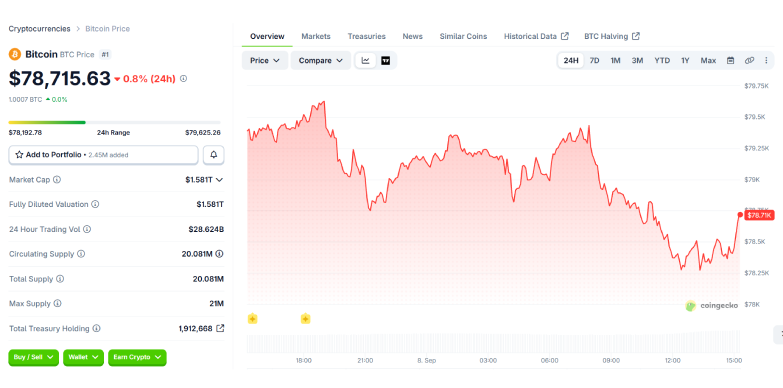
Bitcoin (BTC) slipped toward $78,000 on Tuesday, September 8, 2026, after stronger-than-expected U.S. jobs data increased bets on a Federal Reserve rate hike this month. The price of the Bitcoin token had climbed above $82,000 last week, but since then the price has pulled back, with traders now watching the $77,000-$75,000 area for signs of further weakness.
At the same time, upcoming inflation data and Treasury-market activity could influence the rate outlook before the Fed’s September 15-16 meeting. The latest debate is less about whether Bitcoin is in an immediate uptrend or downtrend and more about how monetary policy, bond yields and financial conditions could affect its next move.
At the time of writing, the price of the token is down by 0.8% in the last 24 hours and is trading at $78,715.63, as per CoinGecko.
Strong Jobs Data Puts Inflation And The Fed in Focus
The U.S. economy added 162,000 nonfarm jobs in August 2026, while the unemployment rate remained at 4.1%, according to the Bureau of Labor Statistics. The jobs gain was stronger than markets had expected and helped push the probability of a September rate increase higher.
There were reports that stated that futures markets were pricing in about a 60% chance of a hike after the employment report. Other market reports also noted that Treasury yields rose following the data.
This change in rate expectations has become an important part of the Bitcoin story. Higher interest rates can make cash and government bonds relatively more attractive when they are compared with riskier assets; on the other hand, higher Treasury yields can tighten financial conditions more broadly.
The next evidence comes on Thursday and Friday. The Bureau of Labor Statistics release calendar shows that August producer prices are due Sept. 10, followed by the consumer price index on Sept. 11. A hotter-than-expected inflation reading could increase expectations for a rate increase; however, softer data could reduce some of that pressure.
The Federal Reserve’s September meeting is scheduled for Sept. 15-16, according to the Federal Reserve’s meeting calendar. This leaves the inflation reports as some of the final major economic inputs before policymakers decide on rates.
The debate is already visible among market participants. Posts collected in the X trending discussion point to possible support around $75,000 and lower targets near $70,000 or $67,000, while other technical analysts see a potential correction before another advance.
Treasury Market Offers A Second Set Of Signals
The U.S. Treasury announced on Aug. 19 that the maximum size of certain liquidity-support buybacks would increase from $2 billion to at least $4 billion per operation beginning Sept. 9, with the change running through Nov. 4. The Treasury said the program is intended to improve liquidity in older Treasury securities.
This matters because movements in Treasury yields are closely watched by investors in other asset classes, including cryptocurrencies. Reuters reported that the 10-year Treasury yield was around 4.79% as markets considered the possibility of a September Fed hike. Its latest market report also noted that investors were awaiting inflation data.
The buybacks have prompted a different interpretation among some crypto traders. The argument is that stronger Treasury demand could support bond prices and help limit upward pressure on longer-term yields. If yields remain contained, that could reduce some of the pressure on risk assets. The relationship between the buybacks and Bitcoin is not direct and will depend on how the broader bond market responds.
Bitcoin’s next move will now be dependent on how the markets digest the incoming inflation data and changing expectations for the Fed’s September meeting. If the inflation data comes out to be hotter than expected or if there is further rise in Treasury yields, then pressure will be added to risk assets, while softer data and easing rate expectations could give Bitcoin room to recover.
As of now, traders are on the lookout for the $75,000-$77,000 range as it acts as an important test of whether the recent pullback can stabilize.