




Key Points:
- South Korea is also considering permitting domestic entities to issue virtual assets, such as stablecoins.
- South Korea is also permitting institutional crypto investment, with a maximum of 5% of company equity going to cryptocurrencies.
- Governor Lee Chang-yong urges the implementation of a two-level system of digital finance and avoids liberalizing the regulations too soon.
South Korea is making a major stride towards the sophistication of its crypto regulatory mechanism. Recently, the Governor of the Bank of Korea (BOK) Lee Chang-yong revealed that the government is considering a new set of registration systems to be used by domestic institutions in issuing virtual assets.
The relocation is attributed to South Korea attempting to promote a stronger digital asset market and to overcome the growing concerns about the risks that the stablecoins present, specifically the ones pegged to the South Korean won (KRW).
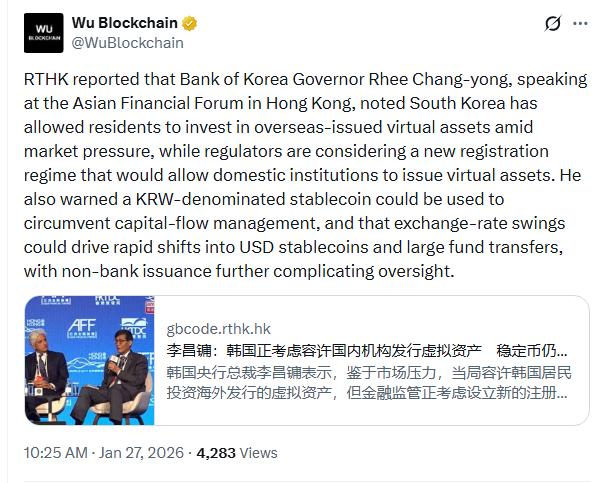
As a measure to address the growing market pressures, Governor Lee, in his speech at the Asian Financial Forum in Hong Kong, affirmed that South Korea had permitted residents to invest in overseas-issued virtual assets. But with the increased attention to digital currencies and stablecoins, government bodies are turning back to devising new systems to control cryptocurrency operations within the country. This involves the option of giving South Korean institutions the right to issue stablecoins. This would be a significant change in the regulatory position of the country, which has a major vision of incorporating digital finance into the economy of the country.
Governor Lee was concerned with the adoption of KRW-denominated stablecoins, pointing to various dangers. He stated that these stablecoins have the potential to circumvent capital flow controls (particularly when combined with US dollar (USD)-denominated stablecoins). According to Lee, USD stablecoins are already common and easily accessible, and the cost of transacting using them is significantly lower than the direct exchange to US dollars. This would render them a good alternative in times of exchange rate fluctuations.
Stablecoins at Risk
Lee cautioned that in the event of exchange rate volatility, it would cause a change of direction on the market, with investors shifting the money to the USD stablecoins. This would result in mass transfer of funds, where people will be transferring huge sums of money across borders. Also, Lee emphasized the fact that non-bank players who issue stablecoins would complicate the regulation of such transactions even further.
Risks associated with KRW-denominated stablecoins are increased by the fact that these digital currencies can lead to the weakening of current capital flows management policies in South Korea. Considering the growing popularity of decentralized finance (DeFi) and the expanding application of stablecoins, the issue of regulating virtual assets that Lee raises is an indication of how complicated the new regulatory framework in the fast-changing financial sector is becoming.
South Korea’s Crypto-Friendly Shift
These concerns notwithstanding, the regulatory landscape of South Korea is getting increasingly friendly towards digital assets. The position of the country is a contrast to the policies of its neighbors, including Hong Kong and Japan, where regulators are restricting their control over crypto activities even more. The Financial Services Commission (FSC), the pro-crypto administration in South Korea, has declared a new framework in which the public companies and institutional investors may commit up to 5% of company equity capital into cryptocurrencies. The change of the policy should promote more institutional involvement in the digital asset market in the country.
This transformation belongs to a larger economic policy described in the 2026 Economic Growth Plan of South Korea that is supposed to implement digital assets into the South Korean financial ecosystem. Liberating the allocation of corporate crypto holdings, South Korea hopes to not excrete considerable funds into the country but instead prevent major outflows that plagued the market over the past years.
This shift towards institutional investors and publicly traded companies being allowed to invest in crypto assets is considered a reaction to the fact that crypto asset outliers that had not been invested in domestically amounted to a hundred and eleven billion dollars in the country in 2025. The change is also a manifestation of a more general awareness of the necessity of regulation that would bring innovativeness and risk control into balance.