


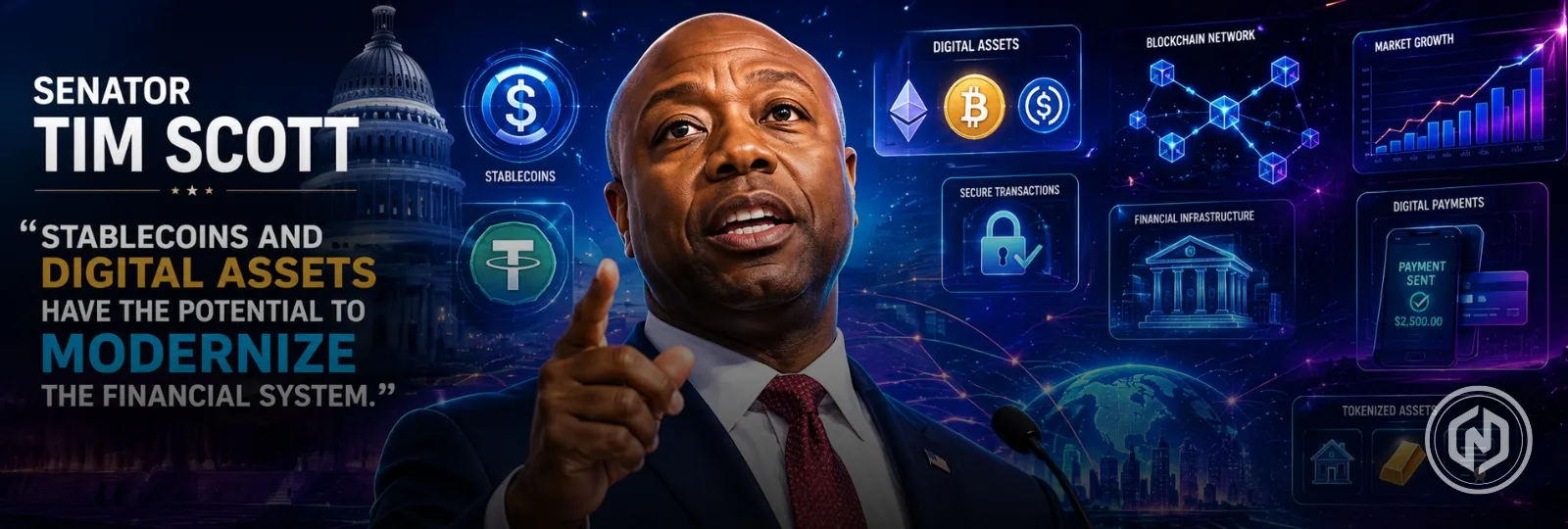


- In the latest post on X, Senator Tim Scott stated that Stablecoins and digital assets have the potential to modernize our financial system.
- Recently, the Senate Committee has advanced the CLARITY Act in the markup session with a 15-9 vote, boosting the investors’ confidence.
- Stablecoin market capitalization has already exploded in the last few years, soaring over $320 billion.
On May 22, Senator Tim Scott made a bullish statement amid the ongoing legislative efforts for the digital asset and stablecoin market after the Senate advanced the CLARITY Act last week.
The statement comes at a time when the U.S. is seeing major regulatory developments under the leadership of pro-crypto President Donald Trump. Scott is actively working on major policy frameworks to develop policy in the United States, which is expected to create clear rules that protect consumers while also encouraging innovation.
Recent Legislative Developments in the Crypto Sector and Stablecoin Market
The United States has witnessed an impressive growth in the last few months. In July 2026, U.S. President Donald Trump signed the GENIUS Act into law. This was the first major federal law for stablecoins that creates strict federal rules for companies that issue stablecoins.
The GENIUS Act ensures that every stablecoin is backed one-to-one by reserves held in cash or short-term United States Treasury securities. These stablecoin issuers will also have to provide monthly public disclosures while following strong consumer protection rules.
It is a framework for both banks and qualified non-bank companies to issue stablecoins. It also includes requirements for licensing, government supervision, and anti-money laundering controls. A confusing mix of different state rules with a clearer national approach replaced this law.
Last week, the Senate Banking Committee, under the leadership of Senator Tim Scott, concluded a much-awaited markup session for the Digital Asset Market Clarity Act, which is mainly known as the CLARITY Act. The vote was 15 in favor and 9 against, with support from both political parties. This bill clarifies the roles of different regulators, such as the Securities and Exchange Commission (SEC) and the Commodity Futures Trading Commission (CFTC), for digital assets beyond stablecoins.
This regulatory framework also includes protections for investors, safeguards against fraud, and rules to fight illegal finance, all while keeping innovation in the United States.
How Regulatory Developments Boost Confidence in Crypto-Based Innovation
These regulatory developments are ending long-standing regulatory uncertainty that had suppressed the adoption of digital assets like Bitcoin. The GENIUS Act and the advancing CLARITY Act have provided relief to digital advanced-based innovations that the United States wants to lead in digital finance rather than fall behind.
These regulatory frameworks are making it mandatory for crypto-based enterprises to hold strong reserves and maintain transparency rules behind trust. It will encourage banks, payment companies, and large institutions to participate in the market.
This has boosted confidence in different ways. For example, it has boosted institutional investment. Major players such as JPMorgan, Visa, BlackRock, and PayPal have shown interest in stablecoin initiatives.
On the other hand, innovation incentives are improving. Regulators are now offering clear guidelines for new products, which will help the service providers to reduce the enforcement risks.
In recent years, global competitiveness has also increased. By creating high standards, the United States is expected to attract business and prevent it from moving to other countries.
Bipartisan support, including from Democrats such as Senators Alsobrooks and Gallego in the committee vote, is showing that there is growing agreement that smart regulation can protect consumers without stopping growth.
The stablecoin market has grown significantly in popularity. As of the middle of 2026, the total market capitalization of all stablecoins has soared to record highs of approximately $322 billion. This is more than 10 times more than in 2021. USDT is the leading market with approximately $190 billion. It is followed by USDC, which is about $77 billion, according to DeFiLIama.
Also Read: Everclear Winds Down Its Operations Over Revenue Issues