




- Polygon price has maintained a steady correction trend since September 2025 amid the formation of a falling wedge pattern.
- Polygon successfully activated the PIP-86 hard fork on its PoS chain yesterday, delivering a key performance boost.
- The open-interest tied to POL’s futures contract has remained stagnant around $65.4 million since January 2026, indicating a cautious approach among derivative traders.
POL, the native utility token for the Polygon ecosystem, is up roughly 1.68% during Friday’s U.S. market hours to currently exchange hands at $0.093. While most of the major cryptocurrencies show a lack of recovery in the last 24-hours, the Polygon price uptick came as a follow-up to the activation of the PIP-86 hard fork on May 21st. The technical upgrade reduces block production and network throughput to strengthen the network’s long-term utility.
Polygon Activates PIP-86 Hard Fork
Polygon successfully activated the PIP-86 hard fork on May 21st, making an important technical upgrade to improve the scalability and efficiency of its Proof-of-Stake (PoS) chain.
The proposal adjusts the CHECKPOINT_REWARD parameter to allow a decrease in block production time from 2.0 sec to 1.75 sec. Another reduction to 1.5 seconds is in the pipeline for the next phase. In doing so, Polygon continues to have a target of about 1% annual emission rate of POL tokens, as discussed in the previous PIP-78.
This upgrade is expected to boost network throughput by approximately 14%, bringing potential transaction speeds to approximately 3,260 TPS. The upgrades are anticipated to boost the efficiency of high-volume applications, payment options, and user experience without raising the validator payouts.
Major exchanges such as Binance, Bithumb, and Upbit halted POL deposits and withdrawals on May 21, but trading continued. No major disruptions have been reported post-activation.
Market reaction was slightly positive as the Polygon price bounced roughly 2% in the last 48-hours.
Meanwhile, the POL open Interest (OI), projecting the outstanding value of outstanding futures and options contracts, has remained largely unchanged since January 2026. According to Coinglass data, the OI value has remained stagnant around the $65.4 million value, indicating a wait-and-see approach from market participants. This lateral trend suggests that while existing positions aren’t being aggressively closed, no significant new money is flowing into the derivative market to bolster price action.
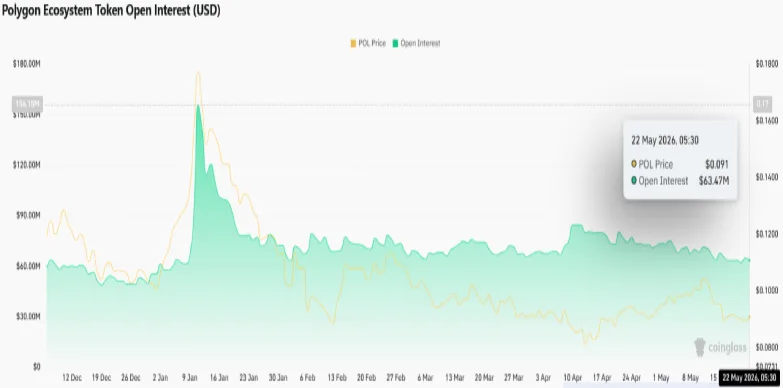
While the price and open interest data show limited immediate movement, the upgrade should have a long-term positive impact on Polygon’s competitiveness in the Layer-2 and payments sector.
Polygon Price Just Inches Away From Major Bullish Pattern Breakout
By the press time, the Polygon price traded at $0.093 mark, positioned just 2.5% away from challenging a long-awaited resistance at $0.095. An analysis of the daily chart shows this downsloping trendline as part of a classic bullish reversal pattern called the falling wedge pattern.
Since September 2025, the POL price has actively resonated within the two converging trendlines of this pattern and witnessed a steady correction trend. A potential retest of the overhead trendline signals another breakout attempt from buyers to escape this pattern-led correction.
If buyers flip the overhead resistance into potential support, the Polygon price could rise roughly 62% to hit $0.153, followed by a leap to $0.186.
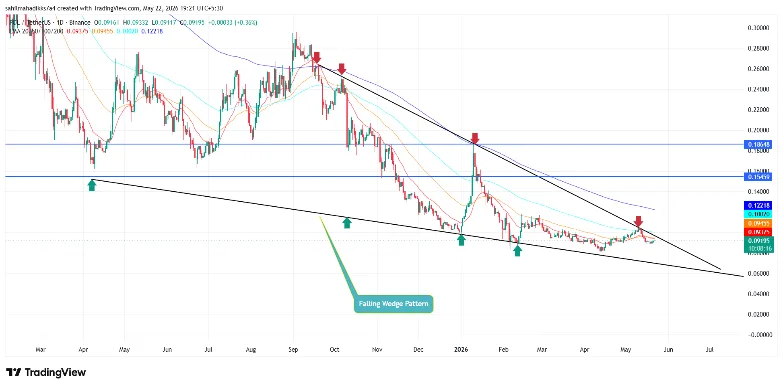
Based on our Polygon forecast, if the coin price witnesses intact supply pressure at this resistance, the sellers may drive a prolonged correction in its value. The POL coin positioned below the daily EMAs (20, 50, 100, and 200) indicates the path to least resistance is down, and the broader market sentiment is bearish.