




Key Highlights
- Japanese Financial Services Agency (FCA) revealed a detailed proposal to transfer oversight of crypto from the Payment Services Act to the Financial Instruments and Exchange Act
- This proposal will treat crypto as investment products with securities-like rules on disclosure and insider trading
- These new rules are expected to protect investors and ensure market integrity
On December 10, the Financial Services Agency (FCA) of Japan revealed a detailed proposal to bring the cryptocurrency sector under the strict regulatory framework.
Japan’s Regulatory Proposes New Rules
This new regulatory framework strives to transfer oversight of crypto from the Payment Services Act to the Financial Instruments and Exchange Act. The latter is the law traditionally used to govern securities such as stocks and bonds.
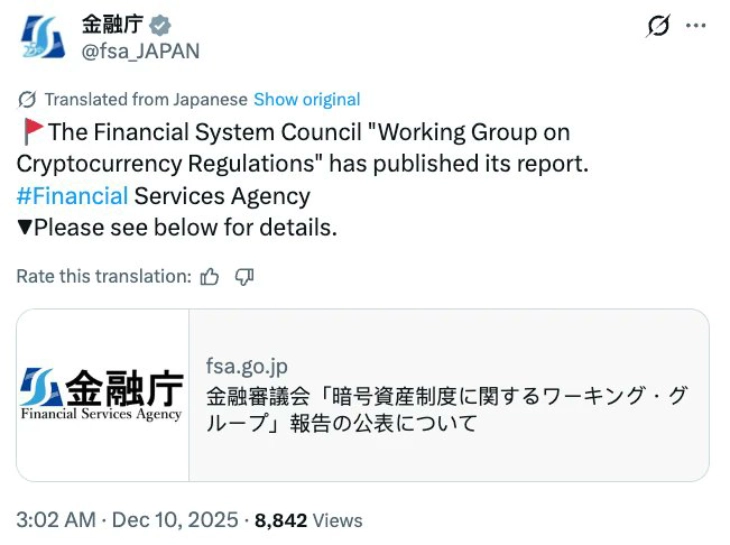
(Source: FSA Japan on X)
In simple words, this new proposal means that cryptocurrencies would be officially treated as investment products, not just payment methods.
According to the official report, the purpose behind this regulatory framework is to impose much higher standards on market participants. If approved, Crypto exchanges would be required to follow strict disclosure requirements, similar to stock exchanges. This would also lead to a ban on insider trading and market manipulation techniques.
The proposal mainly mentions the process of launching new tokens through exchanges, known as Initial Exchange Offerings.
Under the planned system, cryptocurrency exchanges must reveal the identities of token issuers and details on how these tokens are distributed. Not just this, token issuers will also have to disclose their business plans and potential risks clearly. The purpose behind this is to protect retail investors by providing them with complete and reliable information before they invest their hard-earned money.
These regulatory developments will also provide power to regulators to control the digital asset market. They could issue orders to stop unregistered platforms from operating in Japan, even if those platforms are based overseas.
There will be penalties for serious violations, including prison sentences of up to 5 years. This development with stricter rules comes at a time of rapid growth in Japan’s cryptocurrency sector. More than 12 million accounts hold digital assets valued at over 5 trillion yen.
Japan Ramps Up Legislative Efforts for Crypto with Global Shift
Japan was one of the first to formally recognize and regulate cryptocurrency exchanges back in 2017. Now, it is planning to become a front force in investor protection by applying its well-established securities laws to the cryptocurrency sector. Some proponents believe that this will build greater trust, attract larger institutional investors, and help avoid some major collapses like that of the FTX exchanges.
Countries around the world are aggressively working on the development of a regulatory framework for digital assets. Major economies are establishing comprehensive rules for digital assets. The aim globally is to encourage responsible innovation while protecting investors and ensuring financial stability.
In the European Union, a set of regulations called MiCA is now fully in effect. This framework requires cryptocurrency service providers to obtain a license to operate. It sets strict rules for stablecoins, which are digital tokens pegged to traditional currencies like the Euro. These rules demand that stablecoins be fully backed by real reserves and that users can always redeem them.
The regulations have already led to the delisting of some non-compliant tokens on EU exchanges and opening doors for approved assets to expand their offerings.
Similarly, the U.S. has also broken a long period of regulatory uncertainty under the second term of U.S. President Donald Trump. In July 2025, President Trump signed the GENIUS Act into law. This act creates the first federal framework for payment stablecoins. It mandates that these stablecoins must maintain their peg to the dollar.
Another law, the CLARITY Act, is also under development. It provides a clear distinction between which digital assets are commodities and which are securities. This would help determine which regulator oversees different parts of the cryptocurrency market.