





- The Uniswap price faces intense supply pressure at the resistance trendline of the falling wedge pattern, signalling the continuation of the prevailing downtrend.
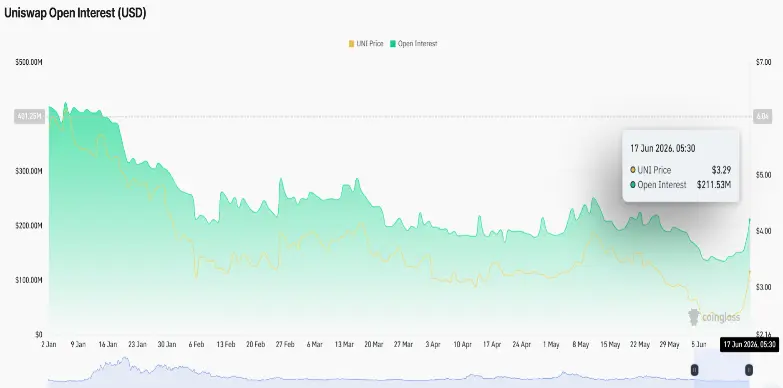
- Futures open interest increased from $135.5 million to $211 million since June 11, reflecting fresh capital inflows.
- A surge in Uniswap’s market activity follows a Standard Chartered forecast that UNI could reach $100 by 2030.
UNI, the native cryptocurrency of the decentralized cryptocurrency exchange Uniswap, jumped roughly 11% on Wednesday to reach a monthly high of $3.75, before reverting to $3.32 immediately. The primary catalyst behind the initial surge was a recent report from Standard Chartered Bank, which shared an ambitious $100 price target by 2030. This major institutional backing has triggered a wave of investor optimism and whale activity, pushing the Uniswap price against a major resistance.
Uniswap Rally Accelerates as Futures Open Interest Hits $211M
Since last week, the Uniswap price has witnessed a bullish rebound from $2.39 to $3.62 high, registering a gain of 51%. Consequently, the asset’s market cap also hit a high of $2.25 billion, and the 24-hour trading volume is up 94.58% to reach $701 million.
Similarly, the Uniswap open interest (OI), projecting the value of outstanding futures and options contracts, has recorded a notable recovery over the past week. According to Coinglass data, UNI’s OI value has bounced from $135.5 million on June 11th to $211 million at press time, projecting a 55.7% increase.
This surge indicates new capital entering the market and high conviction among traders for an upward trend. However, the market participants must remain cautious, as while the high-leveraged positions signal strong bullish momentum, they can also trigger heightened market volatility and increase liquidation risk.
With today’s price jump, the leveraged traders have already witnessed a notable shock as the short liquidation value reached $2.08 million. However, the intraday price volatility also wiped out $1.73M from long-positioned traders.
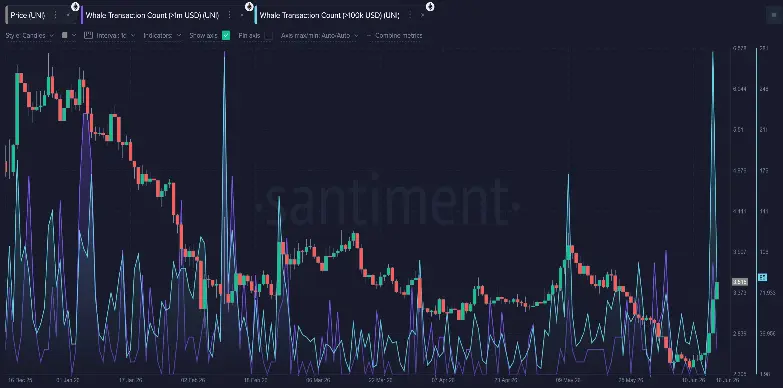
Furthermore, the on-chain analytics platform, Santiment, showed a sharp increase in high-value UNI transfers exceeding $100,000. The number of whale transactions surged to 281 in a 24-hour period earlier this week, up from the typical daily range of 71-85.
Typically, a surge in whale activity along with rising coin prices indicates an accumulation trend in the market. As these large entities often move their tokens to a cold wallet for a prolonged period, their buying pressure strips liquid supply from exchanges, creating a supply shock that can sustain an extended upward trend.
This flurry of market activity came on the heels of a recent Standard Chartered Bank forecast. Analysts at the bank suggested UNI, which at that time traded around $2.70 during, has the potential to climb to $100 by the end of 2030. This prediction is based on the projected growth of tokenized assets in decentralized finance applications.
Uniswap Price Faces Intense Overhead Supply at Wedge Pattern Resistance
Following an intraday high of $3.75, the Uniswap price immediately reverted to $3.32 with a long-wick rejection in the daily candle. A deeper look at the technical chart shows that this overhead supply came from the resistance trendline of a falling wedge pattern.
Since December 2024, the Uniswap price has witnessed a steady correction trend, resonating within the two converging trendlines of this pattern. The coin price rebounded several times from both trendlines, indicating how strongly the pattern influences the market activity.
As the Uniswap price is positioned below the 100-and-200-day exponential moving average, the broader sentiment around the asset is still bearish. Therefore, the sentiment surge from Standard Chartered’s prediction may fade, and the UNI price could revert to nearby support of $3.014, followed by $2.6.
Thus, until the overhead resistance trendline is still intact, the Uniswap price could prolong its long-awaited correction trend.
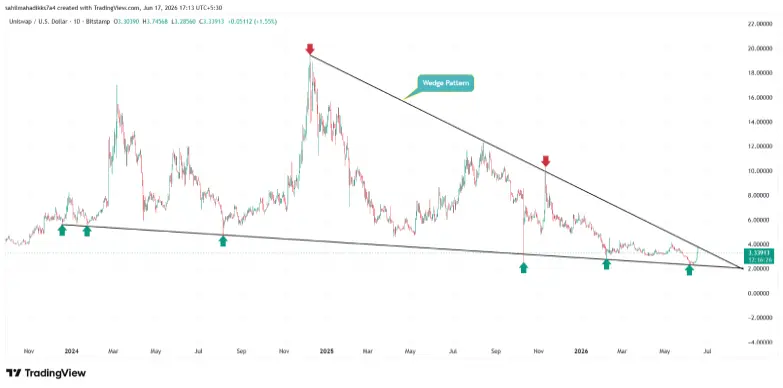
That said, the falling wedge pattern is often viewed as a major reversal pattern, indicating the coin price could eventually breach the upper boundary in the near future.