



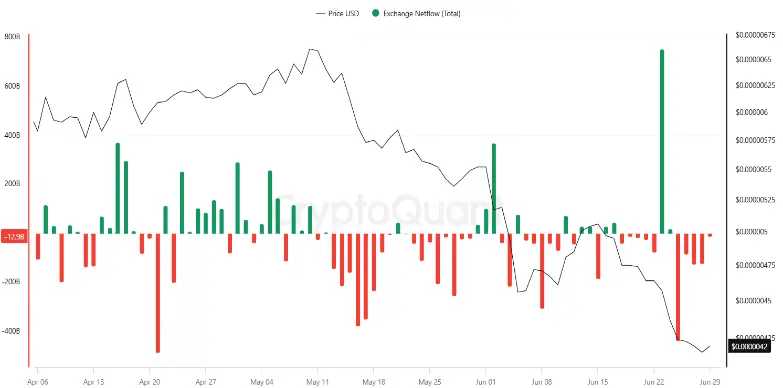
- CryptoQuant data shows approximately 784.95 billion SHIB has flowed out of centralized exchanges over the last five days.
- SHIB’s futures recorded a 52.6% decline in open interest, reflecting reduced speculative forces from the derivative market.
- Shiba Inu price correction seeks support at a long-coming bottom trendline of the falling wedge pattern on the daily chart.
Shiba Inu, the popular dog-themed meme cryptocurrency, shows a slight uptick of 1.5%, ahead of Monday’s U.S. market hours to trade at $0.00000421. While the jump aligns with Bitcoin’s repetitive attempt to hold above the $60,000 level, SHIB’s exchange data shows notable outflow in the last few days, indicating active accumulation from investors in this oversold state. In addition, the Shiba Inu price seeks support at the long-coming support trendline, signalling a potential point for reversal.
Shiba Inu Accumulation Grows Despite Weak Futures Demand
On July 25th, the Shiba Inu price witnessed a notable surge in selling pressure and plunged to a low of $0.00000404 before a short rebound. Since then, the SHIB price has been wavering in a sideways trend, resonating with Bitcoin’s fluctuation around $60,000.
The consolidation reflects a lack of initiation from buyers or sellers amid sticky U.S. inflation data and a lack of new market catalysts. However, the recent exchange data highlights renewed accumulation from SHIB investors as the price attempts to hold above the $0.0000040 floor.
CryptoQuant data shows Shiba Inu has experienced consistent exchange outflows since June 25, with a cumulative 784.95 billion SHIB leaving centralized exchanges over the past five days.
Significant exchange outflow usually means that investors are shifting their coins to self-custody or cold wallets, and not into immediate selling. In the past, exchange withdrawals over an extended time period have decreased the liquid supply available for sale, which has helped reduce sell-side pressure.
Exchange outflows tend to be considered positive on-chain indicators when demand rises, market sentiment is high, or the activity on the network increases, but they do not necessarily herald a price rally.
In addition, Shiba Inu’s open interest (OI), projecting the outstanding value of outstanding futures and options contracts, has shown an aggressive downtrend since mid-May. According to Coinglass data, SHIB’s OI value has dropped from $65.5 million to $31.03 million, registering a 52.6% drop.
The sharp decline in open interest suggests that leveraged traders have been closing positions or exiting the market, reflecting weakening speculative activity. The decline in OI coupled with a price drop has historically signaled diminished involvement and waning bull momentum.
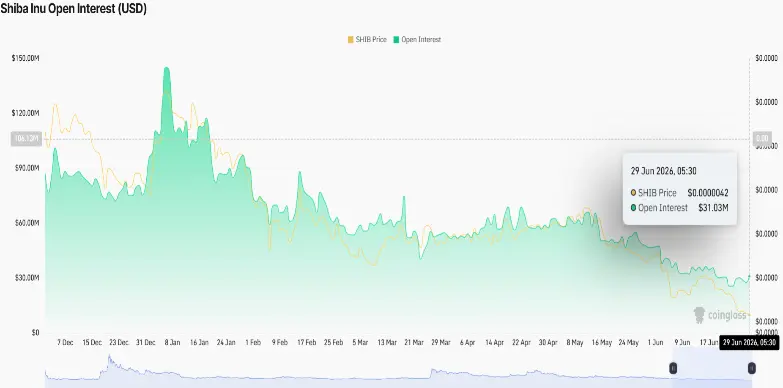
Renewed outflow from exchanges and a falling open interest indicate that the bullish activity of long-term investors has been ongoing, whereas the participation of speculators has dwindled considerably.
Historically, such a setup reflects an accumulation phase with reduced sell-side pressure, though a meaningful price rally typically requires fresh capital to re-enter the derivatives market and push open interest higher.
Shiba Inu Price Sparks Reversal Within a Multi-Year Wedge Pattern
A deeper analysis of the daily time frame chart shows that the Shiba Inu price is consolidating above the declining support trendline, active since August 2024. This support trendline is also part of a long-coming falling wedge pattern that has been carrying the current downtrend in SHIB.
The two converging slopes of this pattern continue to act as dynamic resistance and support for price despite the recent turbulence in the broader market. The Shiba Inu price currently seeking support at this trendline indicates a higher chance of a rebound in the near term.
The daily RSI indicator at 28 signals an oversold trend in price, further reinforcing the rebound opportunity for this memecoin.
However, the recovery potential could be capped just 3.57% away, as the overhead trendline is at $0.0000044, as shown in the chart below.
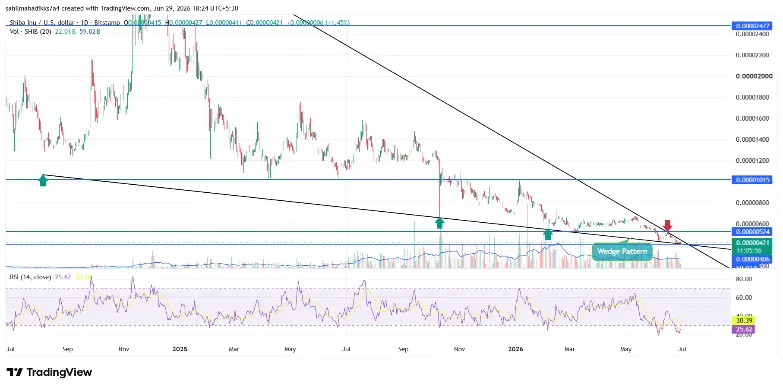
Thus, the Shiba Inu price prediction needs a sufficient catalyst to break this multi-year pattern, which could fuel its next recovery or extended correction depending on the breakout side.