




Key Insights:
- SEC announces conclusion to its Ondo probe without citing violations.
- Outcome signals normative shifts in the direction of positive tokenization systems.
- Ondo is now well-poised to contribute to the U.S on-chain finance growth.
The SEC officially ended its secret probe of Ondo, a probe spanning the Biden era, without any charges. The watchdog has cleared a regulatory haze that had hovered over one of the fastest-growing names in the real-world asset tokenization. Its inquiry, initiated in 2024, determined whether the tokenized Treasuries and other real-world asset products offered by Ondo adhered to the U.S. securities law. The probe was also meant to determine whether the ONDO token was a security.
A Case Shaped by the Tokenization Boom
Ondo gained the center of attention of regulators as tokenized Treasuries gained popularity. By 2024, the firm had become one of the first mass issuers of tokenized government securities, when the SEC was actively seeking the enforcement of digital-asset activities. The speed of the company’s growth and its impact on the new tokenization market precondition the extension of the process of the review of its products, organizational structure, and compliance system.
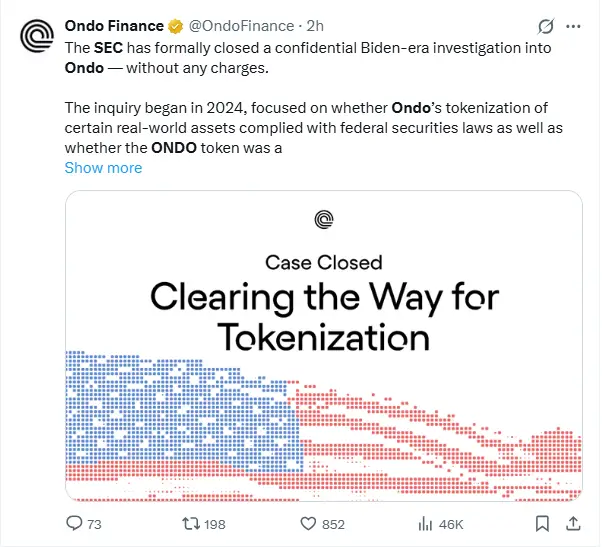
Ondo Announcement on SEC Probe | Source: X
In the entire process, Ondo argued that it was possible to digitize very established financial instruments like U.S Treasuries and publicly traded equities without a change in regulations. One of the recurrent arguments that the company made is that tokenization increases transparency and better settlement efficiency. The firm also argued that it expands access to the markets without compromising the protections of investors.
Does Ondo’s Case Mean a Clearer Path for Crypto?
The move to stop the investigation highlights a broader regulatory shift that is already evident throughout the SEC’s newly published 2026 Examination Priorities. In contrast to the past years, the agency agenda includes no reference to crypto, digital assets, tokenization, or blockchain, which represents a shift in the enforcement-intensive stance of 2024 and 2025.
Such an evolution coincides with the larger policy changes of the White House, which in early 2025 published guidelines to expand digital assets responsibly, an ambitious U.S. Bitcoin store, and new coordinating mechanisms, including the Presidential Working Group on digital asset markets. Leadership transitions at the SEC also helped change the tune to a more focused approach. The new chair, Paul Atkins, now focuses on capital formation, rather than taking broad punitive measures, and the hiring of Meg Ryan as enforcement director indicates a more focused, narrower stance.
New precedents support this development. The SEC concluded its decades-old Ripple lawsuit, which resulted in a limited injunction, abandoned its case against Coinbase, and terminated an investigation into the crypto business of Robinhood without any charges. The Ondo result is a perfect fit into this current trend of reconciliation instead of intensification.
Growing Acceptance of Tokenization in U.S. Markets
The termination is a significant milestone not just in Ondo but also in the entire tokenization ecosystem. The pace of adoption in the market is taking off all over the world, and U.S. infrastructure is slowly evolving to accommodate institutional-grade tokenized assets. One such example of companies developing regulated venues for on-chain finance can be the acquisition of Oasis Pro Markets by Ondo earlier this year.
Tokenized Treasuries have become one of the most robust applications of digital assets, with institutional investors finding it to be a platform to offer programmable liquidity, more rapid settlement, and transparent tracking of assets. Having removed the regulatory barrier, Ondo can now be considered the first to influence the new era of modernization of the U.S. market.
The decision is perceived by market observers as a good omen. This comes as a new policy change to no longer enforce crypto-specific regulations by the SEC just happened. Together with increasing government and industry cooperation, this would indicate a ground-level role of tokenization in future market infrastructure.