



The next five years are going to define where Cardano ranks in the blockchain pecking order. As blockchain adoption grows and global regulation tightens, the network is stepping into a phase where scaling, governance, interoperability, and Real-World Asset integration take center stage.
Global crypto regulation is finally taking shape, which means networks like Cardano that prioritize compliance and predictability have an advantage. But advantage doesn’t guarantee success. Execution matters.
In this guide, we’re breaking down what’s planned, what each upgrade means, and where Cardano stands compared to faster-moving chains. You’ll get the full picture on governance activation, new scaling layers, privacy infrastructure through Midnight, RealFi expansion, and how all these pieces connect to ADA’s long-term market position.
Quick Overview of Cardano’s Base Roadmap Structure
Cardano’s never been the type to rush. The entire roadmap follows a phase-by-phase structure, with each era tackling a specific part of the network’s evolution. The first phase was Byron, which established Cardano’s basic architecture. Then came Shelley, pushing hard on decentralization, bringing in stake pools and delegated staking.
Goguen followed with smart contract functionality, finally letting developers build applications on-chain. Now we’re in the overlap between Basho, which focuses on improving the network’s scalability, and Voltaire, which brings governance into the hands of the community. And then there’s the Intersect Era, which basically coordinates all the committees and working groups steering further development.
Each phase is rooted in peer-reviewed research and formal verification, which is a slower but more predictable approach. This approach is what sets Cardano up for the heavy lifting that needs to happen between now and 2030.
Where Cardano Stands Today
As of now, Cardano is close to fully activating its governance framework. Voting, budgeting, and community committees within Intersect continue to expand, setting the stage for a deeper shift toward community-driven decision-making.
On the technical side, Hydra is progressing through advanced testing, aiming to support faster settlement for quicker transactions. Leios introduces a fresh approach to handling consensus bottlenecks, while Input Endorsers help streamline block production, keeping the network smooth even during heavy activity.
RealFi is another fast-moving area. Tokenization experiments, stablecoin development, and enterprise-grade pilot programs are bringing Cardano’s financial infrastructure closer to real-world use.
Midnight, the network’s privacy-focused partner chain, is also growing and preparing for regulated enterprise applications powered by zero-knowledge tech. That’s a big deal because privacy and compliance rarely co-exist, but Cardano’s betting can balance both.
Cardano continues to show strong development activity across its repositories. For a deeper look into why the ecosystem is active despite all the noise, check out our analysis on why Cardano isn’t dead.
Cardano Roadmap: What to Expect
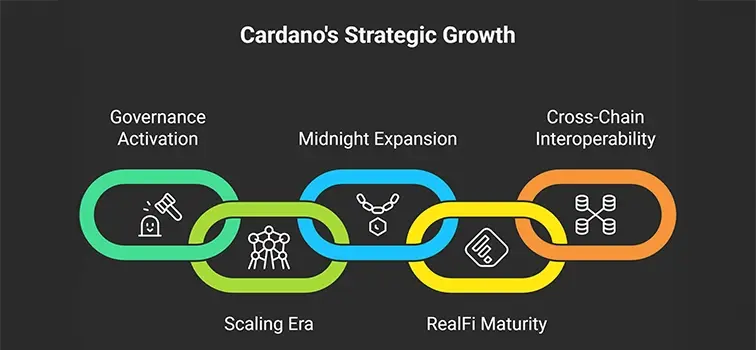
1. Full Governance Activation & Cardano Constitution
One of the biggest milestones ahead is the full rollout of Cardano’s governance system, starting with the Cardano Constitution. This document outlines the network’s operating rules through a transparent community vote.
ADA holders will vote on upgrades and elect representatives for committees. Intersect coordinates the entire governance process. It manages working groups, keeps committees aligned, and makes sure decisions don’t happen behind closed doors.
For anyone holding ADA long-term or any institution considering blockchain infrastructure, governance transparency reduces political risk and makes Cardano easier to integrate into formal systems.
2. Scaling Era: Hydra, Leios & Input Endorsers
Hydra introduces a new way to scale the network by enabling multiple “heads” that process transactions in parallel. It’s ideal for fast interactions while everything still anchors to the main chain.
Leios separates validation from consensus, which lets the network process more transactions without increasing block size. Input Endorsers smooth out block production by allowing transactions to be pre-validated before they’re added to a block.
Combining these upgrades could scale throughput from the current 250-300 TPS to 1,000 TPS, possibly reaching 10,000 TPS, and open the door for more active DeFi markets, higher liquidity, and broader adoption of real-world assets.
3. Midnight Expansion & Privacy Smart Contracts
Midnight is Cardano’s privacy-focused partner chain, designed specifically for confidential applications using zero-knowledge proofs. Developers can build tools that protect sensitive data but still allow for audits when regulators require it. This is particularly valuable for enterprise operations, regulated services, and cross-border processes.
Networks like Ethereum, Solana, and ICP either have fragmented privacy solutions, no privacy, or just lack Cardano’s governance structure. Midnight put Cardano in a unique position as one of the few chains that can pair privacy with compliance
4. RealFi + RWA Maturity Phase
RealFi is Cardano’s term for connecting blockchain infrastructure to real-world financial activity. Between now and 2030, expect more stablecoin products, lending applications, tokenization frameworks, and on-chain identity tools.
Regulated stable assets like the USDA could help create smoother liquidity flows. Government and corporate RWA pilots are accelerating as Cardano continues presenting itself as a secure, predictable network with strong governance.
Asset tokenization is moving beyond proof-of-concept, and Cardano is positioning itself as the settlement layer for these assets.
5. Cross-Chain Interoperability and Partner Chains
Multichain connectivity isn’t optional anymore — it’s central to Cardano’s long-term vision. Partner chains can anchor to Cardano’s security model while operating with their own specialized features. Sidechains like Milkomeda already help connect Cardano to ecosystems like Ethereum and Bitcoin.
If Cardano can become the settlement layer for a wider web of interconnected chains, it shifts from being one competitor among many to being foundational infrastructure.
Ecosystem Predictions: What Cardano Might Look Like by 2030
With the current pace of development, Cardano could enter 2030 with a much larger developer community and thousands of active projects across DeFi, identity, tokenization, and interoperability.
A more scalable network and stronger governance could encourage more builders to stick around long-term, which naturally leads to more liquidity and deeper ecosystems. Currently, Cardano’s TVL is approximately $186M. It could grow significantly as RealFi and enterprise applications mature, supported by privacy solutions from Midnight and regulated stable assets like the USDA.
Cardano may also solidify a role as a trust anchor, acting as a reliable settlement layer in a multichain world where assets and applications move across different networks. Its research-first approach, while slower, lays a foundation for the stability and predictability that enterprise and government clients typically look for.
Will Cardano become one of the top three networks by market cap? That depends on execution and broader market conditions. But the infrastructure being built now is designed for long-term relevance, not short-term price pumps. That matters more than people think.
ADA Price & Market Impact: How Upgrades Influence Long-Term Valuation
There are a few major roadmap milestones that shift market sentiment around ADA. One is the governance activation, which could be a boost in confidence for long-term holders who prefer predictable, community-driven decision-making. Scaling upgrades can attract new liquidity into DeFi and RWA markets, as higher throughput typically means more activity and more users.
Institutional interest may also rise once privacy features, tokenization tools, and cross-chain frameworks reach maturity. These are the features enterprises care about. ADA’s long-term direction will still depend on execution, ecosystem growth, and broader market conditions, but the upgrades outlined here are the kind that set the motion for serious capital.
For a detailed breakdown of long-term ADA forecasts, explore our realistic Cardano prediction based on technicals, fundamentals, and future roadmap milestones.
Challenges & Risks
Cardano’s research-based development style is deliberate and slow, which can be brutal in a fast-moving industry where users expect quick updates. Competing chains with higher TVL or faster iteration cycles can shift attention away from Cardano.
Regulations may also influence how privacy and tokenized assets operate, and the network must constantly refine its UTXO model to keep up with more complex smart contracts. That creates friction for developers coming from other ecosystems.
Still, the team and community continue working on technical standards, governance structures, and interoperability solutions to manage these challenges as the ecosystem grows. The question isn’t whether Cardano will face obstacles. It’s whether it can adapt fast enough when those obstacles show up.
Conclusion
Cardano’s roadmap lays out a clear plan focused on governance, scaling, privacy, RealFi, and multichain connectivity. The network continues to build on its research-first approach, aiming for long-term reliability and strong security guarantees.
While markets may fluctuate in the short term, the roadmap points out a steady vision for Cardano’s evolution. One that supports enterprise use cases, developer growth, and broader blockchain adoption over the next several years. Whether that’s enough to compete with faster-moving chains depends on execution. But the foundation being built now is designed to last.