

In a bearish 2026 crypto market defined by muted price action and cautious sentiment, real-world asset tokenization is quietly having a breakout year. Real-world asset (RWA) tokenization has grown past $30 billion in on-chain value, with major institutions accelerating deployments.
Institutions like BlackRock are leading the charge through tokenized funds such as BlackRock USD Institutional Digital Liquidity Fund (BUIDL).
Tokenization bridges traditional finance’s (TradFi) $400 trillion ecosystem with decentralized finance (DeFi), potentially unlocking $11-$30 trillion in value by 2030 through enhanced liquidity, fractional ownership, and programmable efficiency.
From roughly $22-30 billion today to trillions within the decade, 2026 is shaping up to be the year of acceleration.
What Is Tokenization and Why It Bridges TradFi-DeFi
At its core, tokenization is the process of digitizing real-world assets such as real estate, U.S. Treasuries, equities, private credit, commodities, and even art into blockchain-based tokens. These tokens enable fractional ownership, faster settlement, and programmability, transforming traditionally static financial instruments into dynamic, interoperable digital assets.
Settlement that once required T+2 clearing cycles can occur in minutes. Compliance rules can be embedded directly into smart contracts. And assets can plug seamlessly into decentralized finance protocols for lending, collateralization, and liquidity provision. Real-world assets tokenization essentially acts as a bridge between TradFi and DeFi.
Traditional finance holds the majority of global wealth but operates with limited trading hours, multiple intermediaries, high minimum allocations, and slow settlement rails. DeFi, by contrast, operates 24/7 with near-instant settlement and global accessibility, but historically lacked stable, yield-bearing assets to anchor its ecosystem.
This is where TradFi tokenization becomes transformative. It doesn’t replace traditional finance but upgrades it.
Institutional Validation
The real-world numbers show the momentum behind real-world assets tokenization:
- The BlackRock USD Institutional Digital Liquidity Fund (BUIDL) surpassed $2 billion in assets shortly after launch, offering blockchain-native exposure to short-term U.S. Treasuries.
- Tokenized gold products such as PAX Gold have helped push the market capitalization of the tokenized gold market beyond $3 billion.
- Tokenized U.S. Treasuries grew more than 500% between January 2024 and April 2025, reaching approximately $8.2 billion. In 2026 alone, tokenized US Treasury holdings have risen by over $1 billion, bringing the total to more than $10 billion.
Meanwhile, stablecoins, which are arguably the first successful large-scale RWA category, have expanded beyond $290 billion in market cap. From 2022 to 2025, the total tokenized RWA value grew roughly 5x, exceeding $30 billion according to multiple industry trackers
In a 2024 report, McKinsey & Company estimated the tokenization market could reach $2 trillion by 2030 under conservative assumptions and possibly $4 trillion in bullish scenarios.
Market Projections: The Path to Trillions by 2030
Forecasts for RWA tokenization for 2030 vary widely, yet almost all institutional research agrees on one direction: exponential expansion.
- ARK Invest projects that tokenized assets could reach $11 trillion within the decade.
- BCG (Boston Consulting Group) estimates the market could grow to $16 trillion by 2030, at roughly 10% of global GDP.
- A joint outlook from Ripple Labs and BCG forecasts $18.9 trillion by 2033.
- Citigroup offers a more conservative $4-5 trillion base case.
- More aggressive scenarios push toward $30 trillion by 2034.
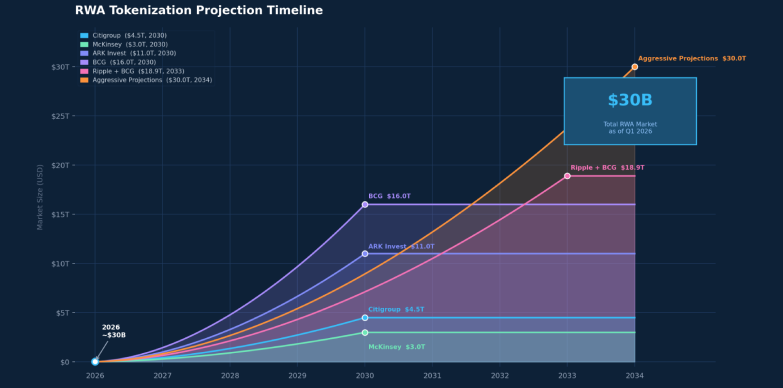
Even the most conservative projections would imply over 100x growth from today’s approximately $30 billion base. The aggressive scenarios would require a 50,000% expansion to reach the $30 billion projections.
At first glance, those numbers sound unrealistic, but context matters. Global bond markets exceed $130 trillion. Global real estate surpasses $300 trillion. Derivatives markets exceed $ quadrillion in notional value. Tokenization only needs to capture a fraction of them.
Several drivers make these projections plausible
Institutional Inflows
Institutional inflows are the most visible driver. Asset managers and banks are exploring tokenized funds to reduce settlement times and improve balance sheet efficiency. Robinhood launched tokenized U.S. stocks and ETFs on Arbitrum for European users in 2025, bringing RWA concepts to retail investors at scale for the first time.
Regulatory Clarity
Regulatory clarity has been the other major catalyst. The U.S. GENIUS Act provided clearer frameworks for tokenized assets in 2025. Emerging stablecoin frameworks in major jurisdictions, including the U.S. and UK, provide compliance pathways for on-chain finance. These developments remove the barrier that previously kept institutional capital on the sidelines.
Infrastructure Maturity
Networks such as Ethereum and Solana now support higher throughput and lower costs, making institutional-scale tokenization feasible. Chainlink’s CCIP protocol is enabling tokenized assets to move across different blockchains.
Use Cases
The most significant real-world use case beyond Treasuries may be trade finance. The global trade finance gap is estimated at around $2.5 trillion. Tokenized trade finance instruments could close that gap by making short-term credit more liquid and accessible to a wider pool of investors.
Challenges
There are still a few challenges. Regulatory frameworks still differ across jurisdictions, making cross-border tokenized products complex. Secondary market liquidity for most RWA tokens is still thin, with products often restricted to accredited investors.
TradFi operates on standardized messaging systems and custodial frameworks. For tokenization to scale, cross-chain interoperability and unified compliance standards must reduce fragmentation.
Opportunities and Strategies for Investors in 2026
For investors, the RWA tokenization space in 2026 offers an early-stage opportunity with institutional-grade validation.
The most immediate opportunity is democratized access. Asset classes previously restricted to institutional allocators, including private credit, real estate debt, and short-term Treasury funds, are now available to a wider range of investors through tokenized products.
Tokenized U.S. Treasuries frequently offer competitive yields, now accessible on-chain. This creates a bridge between DeFi liquidity and TradFi-grade credit quality. Instead of parking capital in volatile assets, investors can allocate to programmable, yield-generating instruments.
Platforms worth watching:
- Ondo Finance ($ONDO): $1.6 billion in tokenized Treasury liquidity with growing institutional integrations, one of the most established names in on-chain yield.
- Centrifuge ($CFG): A pioneer in tokenized private credit, recently partnering with Aave to bring RWA liquidity deeper into DeFi.
- Securitize: Controls around $4 billion in tokenized assets and is the platform of choice for BlackRock’s BUIDL.
Diversify RWAs
Diversifying across RWA types such as Government securities, corporate bonds, commodities, real estate, structured credit, and trade finance is also worth considering. Diversification may mitigate risks tied to specific sectors.
Monitor Regulations
Regulatory developments will continue to act as major catalysts. Watch the U.S. SEC’s proposed DLT securities exemption, MiCA implementation, and any international framework for cross-border tokenized assets. Clear frameworks for stablecoins and digital securities in major financial hubs could also act as catalysts for the next leg of expansion.
RWA Tokenization FAQs
What are the top RWAs to watch in 2026?
Tokenized U.S. Treasuries (BUIDL, BENJI, OUSG) are the most liquid and institutionally validated. Tokenized private credit (Maple Finance, Centrifuge, Goldfinch) has the highest current TVL. Tokenized real estate debt (Figure, RealT) carries the most upside potential for early movers.
How big can the RWA market get?
Base projections range from $2-5 trillion by 2030, while aggressive forecasts extend toward $16-30 trillion. Even conservative estimates imply one of the largest infrastructure upgrades in financial history.
Conclusion
Tokenization is the quiet revolution connecting traditional finance to blockchain rails. While much of the crypto market cycles through speculation, real-world assets tokenization is building enduring infrastructure.
It’s a quiet, structural overhaul of how ownership and liquidity work in global finance, backed by the world’s largest institutions, and supported by regulations that are finally catching up. By the end of the decade, trillions of dollars could move seamlessly on-chain. Position yourself now.