




Key Insights:
- Binance becomes the first exchange to secure a global license under ADGM.
- Three licensed entities will separately run trading, clearing, custody, and brokerage.
- Approval reinforces ADGM’s role as a global hub for responsible digital-asset regulation.
Binance has secured full authorization from the Financial Services Regulatory Authority (FSRA) of Abu Dhabi Global Market. The firm is now the first cryptocurrency exchange to receive a global operational license under the ADGM regulatory framework.
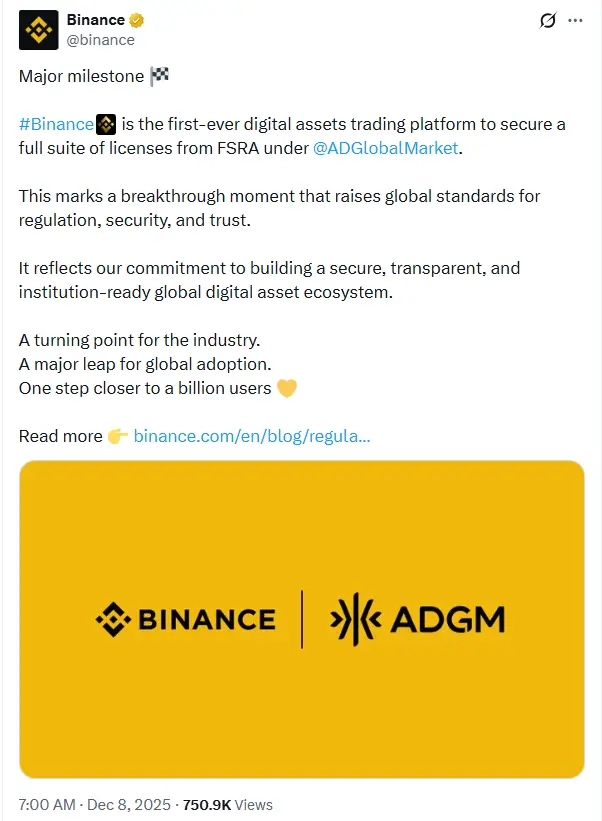
Binance Announcement | Source: X
The new license will legally enable Binance to operate under the supervisory standards of ADGM from January 5, 2026. The move comes as more exchanges seek regulatory compliance amid tightening requirements.
A Global License Built on Market Infrastructure Standards
In order to meet the requirements of ADGM, Binance will work in three separate licensed subsidiaries to segregate the core areas of operation. The subsidiaries include trading, custody, clearing, and brokerage. This model refers to the existing frameworks in international equities and derivatives markets. The model aims to enhance transparency, market integrity, and protection for users.
Nest Services Limited, to be renamed to Nest Exchange Limited, will run Binance’s on-exchange activities as a Recognised Investment Exchange. It will operate a Multilateral Trading Facility that covers spot and derivatives markets under rules consistent with major global exchanges. The entity offers order markets where there are very clear standards of fair trading and sound governance.
The Nest Clearing and Custody Limited has received a Recognized Clearing House and further custodian and CSD services license. This subsidiary will deal with clearing settlement, and secure storage of assets with tight operational safeguards. It is concentrated on segregation of assets, resiliency, and total oversight of post-trade functions.
BCI Limited, to be renamed Nest Trading Limited, shall be a licensed broker-dealer with the permissions to deal in investments, arrange investment transactions, money service provider, and manage assets. The entity will spearhead off-exchange services of Binance, such as OTC and conversion services. It will be distinctly separated in terms of exchange and clearing services to minimize conflicts of interest and enhance risk management.
ADGM is currently known as an international leader in terms of financial-market regulations, supervisory authority, and progressive digital-asset standards. The framework is generally regarded as one of the most detailed digital asset regulatory systems. The framework provides clarity on market structure, operational risk, consumer protection, auditing, and custody.
Regulatory Clarity Strengthens Binance’s Global Expansion Strategy
The new licensing framework comes at a moment when Binance is becoming increasingly active in terms of its regulatory reach to numerous jurisdictions. The exchange has recently been collaborating with policymakers to make oversight uniform. The exchange is now attempting to work on structures that are designed on an institutional scale, where risk controls and the governance models are compulsory. This involves the segregation of the exchange, clearing, and brokerage services, a method that was previously employed in the traditional markets.
The conditions of the ADGM model are aimed at increasing transparency and a more organized way of running the operations. Users can now have a better understanding of how assets are held, settled, and secured. Regulators can also have a line of sight throughout the whole chain of operation.
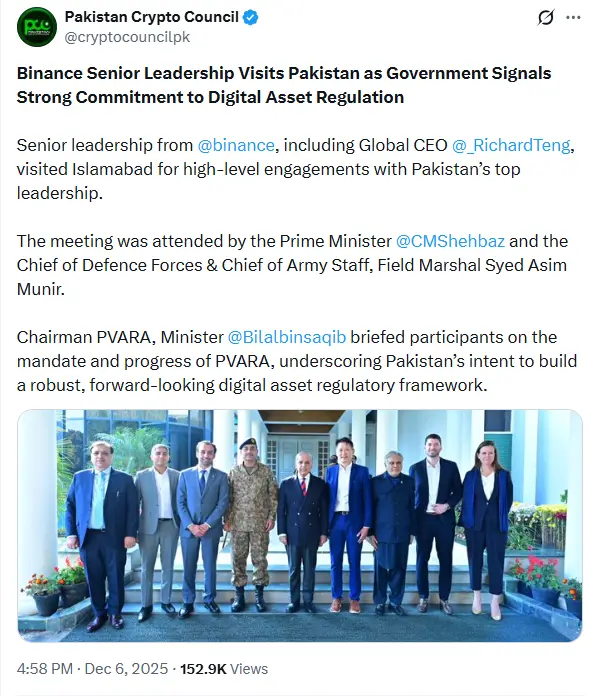
Binance Visit Announcement | Source: X
The ADGM licence comes after a series of regulatory interactions of Binance in various nations. The recent meetings in Pakistan are indicative of the push in the exchange to aid new national structures in the areas that have a fast version of crypto adoption. Binance executives recently held a meeting with the political and defense leadership in Pakistan.
The talks were based on the country’s move to develop its licensing regime. The ADGM framework gives it a centralized regulatory structure while maintaining global distribution of talent and technology.