




- An attacker exploited a deprecated Aztec Private Rollup Bridge contract on Ethereum, siphoning approximately $2.165 million in crypto assets on June 17, 2026.
- Just three days ago, Aztec Network faced a similar exploit that drained roughly $2.19 million from the legacy Aztec Connect contract.
- A falling wedge pattern on AZTEC’s daily chart suggests the ongoing price correction may be nearing completion.
Aztec Network, the layer-2 scaling solution of Ethereum, faces major security concerns after an attack drained roughly $2.165 million from its obsolete Private Rollup Bridge contract on June 17, 2026. This incident followed a similar exploit that took place just three days ago and drained $2.19M from the legacy Aztec Connect contract. While the Aztec network’s current operation remains unaffected, the coin price recorded a 2% drop in the last 24-hours.
Aztec Network Faces Second Exploit on Legacy Bridge Contracts
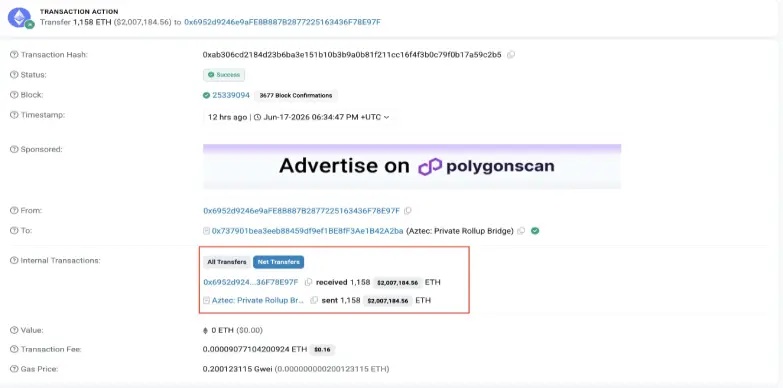
On June 17, 2026, an attacker drained roughly $2.165 million in digital assets from an outdated Aztec Private Rollup Bridge smart contract on Ethereum. The contract, located at address 0x737901bea3eeb884590df9ef1be8ff3ae1b42a2ba, processed three quick transactions that moved 1,158 ETH, 150,000 DAI, and about 0.47 renBTC. Security companies SlowMist and PeckShield followed the activity and saw that the funds were sent to other wallet addresses later.
According to the blockchain data, the original attacker wallet was funded with approximately 0.134 ETH from the HitBTC deposit wallet. The exploit included providing invalid zero-knowledge proof data that the contract accepted as valid deposit balances because of the contract’s flaw in the verification process.
Since the contract is immutable and the project team had previously given up administrative control when decommissioning the system in March 2023, the withdrawals could not be stopped or reversed.
As stated earlier, the current incident came after a similar event that happened three days earlier. On June 14, 2026, a separate attacker extracted approximately $2.19 million from the legacy Aztec Connect RollupProcessorV3 contract. That breach stemmed from incomplete validation in the computeRootHashes function, allowing mismatched zero-knowledge proofs to create unauthorized balances. Assets taken included roughly 909 ETH, 270,000 DAI, and other tokens like wstETH.
Aztec Labs said both of the affected contracts were from outdated versions of the bridge that were discontinued years ago. The current Aztec Network and its operations remain separate and unaffected by these events. In 2023, the team fully gave up the keys to ensure decentralization, and there were no chances to intervene with the old code.
Forensic evidence shows that the attack on June 17 was meticulously planned and involved the use of the deprecated logic for verifying deposits, which sidestepped usual authentication processes. Similar patterns appeared in the earlier incident.
Today’s incident proves that even when a particular crypto project shuts down, its old smart contracts stay live and can be easily targeted by attackers if they hold residual capital.
AZTEC Price Poised to Retest Crucial Multi-Month Support of Reversal Pattern
Amid these recent exploits, the Aztec price witnessed a bearish pullback from $0.0184 to $0.0157, accounting for a 14.7% loss. If the market sentiment remains bearish, the coin price could extend this downswing another 13.2% to retest the bottom trendline of a falling wedge pattern.
Over the past four months, the two converging trendlines of this pattern have created a steady downtrend for Aztec traders, where the coin price activity bounces within the dynamic resistance and support. The daily RSI index at 39 reinforces the bearish market momentum and risk of prolonged price correction.
However, this chart pattern is traditionally viewed as a major reversal setup in the crypto market. Therefore, the coin buyers could likely defend the $0.01355 support, which closely coincides with the bottom support trendline.
A potential rebound from this support could allow bulls to rechallenge the immediate resistance of $0.018 and wedge pattern resistance.
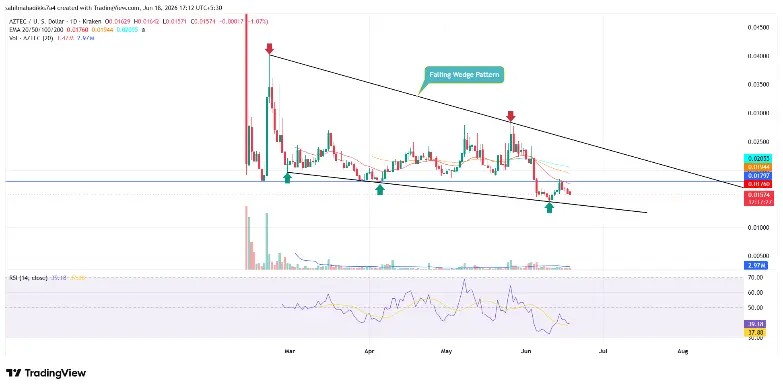
On the contrary, a bearish breakdown below the lower trendline will invalidate the bullish thesis and drive an accelerated downtrend toward $0.01.